By Ernest Salwell. To some, Black nationalist Marcus Garvey was a swindler and a convicted con man. To those with a more educated opinion, he was an energetic sage who understood the needs of the Black community better than any Negro leader before or since. Here is his story.
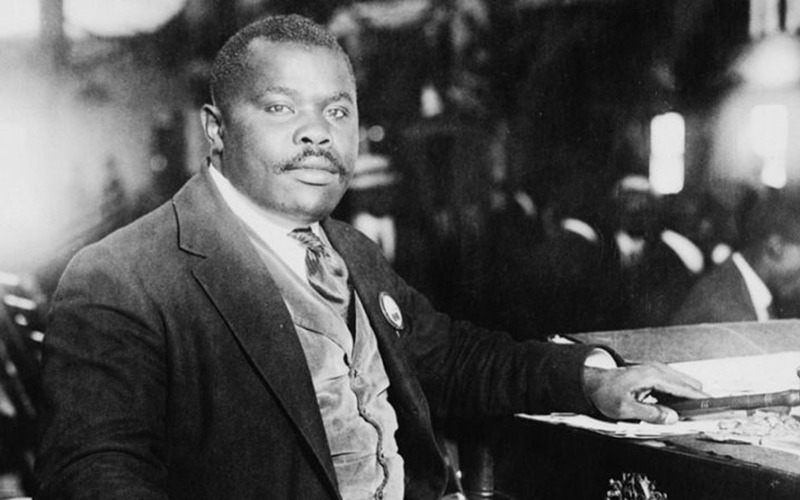
In one of his last acts in office, President Joe Biden posthumously pardoned Black nationalist Marcus Garvey in January 2025. Members of Congress from the Black Congressional Caucus had long been agitating for such a pardon, arguing that his conviction for mail fraud in the 1920s was “politically motivated.”
The conviction was indeed politically motivated, but, contrary to what the Black Congressional Caucus would want to believe, the real culprits for Garvey’s railroading into prison were not the ubiquitously blamed “whites,” but the Jewish lobby, who correctly saw Garvey’s Black nationalist organization as a primary threat and rival to the Jewish-led and funded organization, the National Association for the Advancement of Colored People (NAACP).
Garvey’s Background
Marcus Garvey (1887–1940), perhaps one of the most famous Black leaders in American history, was born in St. Ann’s Bay, Jamaica, the descendant of African slaves imported to the Caribbean during the Atlantic Slave Trade era.
From an early age, he demonstrated singular intellectual ability, which automatically differentiated him from many of his peers. After a brief period working in a print shop in Kingston, he eventually gathered enough capital to move to London in 1912. There, he studied law and philosophy at the University of London’s Birkbeck College and became a staunch black nationalist, believing that the only path to racial peace was the complete physical and geographical separation of the races.
It was this view that differentiated him from all other Black leaders at the time and made him so dangerous to those forces who sought enforced racial integration and mixing. His threat level rose exponentially as his following began to grow.
“Universal Negro Improvement Association” Founded
By 1914, he had returned to Jamaica and founded the Universal Negro Improvement Association (UNIA). By 1916, however, he had left for the United States. Settling in New York, he continued work as a printer while launching his public political career as a Black rights activist.
It was in New York that he authored the “Declaration of Rights of the Negro Peoples of the World,” which condemned European colonial rule across Africa and was presented at the UNIA launch meeting in America, held at Madison Square Garden in 1920.This meeting was attended by over 25,000 Blacks, and the guest of honor was Gabriel Johnson, the Mayor of Monrovia in Liberia. (That nation, it will be recalled, had been founded in 1821 by the American Colonization Society (ACS), an organization established by American abolitionists and slaveholders who believed that freed African Americans should be resettled in Africa rather than remain in the United States.
The ACS negotiated with local West African leaders to acquire land, and in 1822, the first freed Blacks from the United States began settling in what became Liberia. In 1847, Liberia declared itself an independent republic, with a government and a constitution modeled after that of the United States.)
Garvey’s Influence Spreads
Within just 18 months, UNIA had branches in 25 U.S. states, as well as divisions in the West Indies, Central America, and West Africa. Garvey was a gifted orator whose often controversial street tactics won him mass popular appeal.
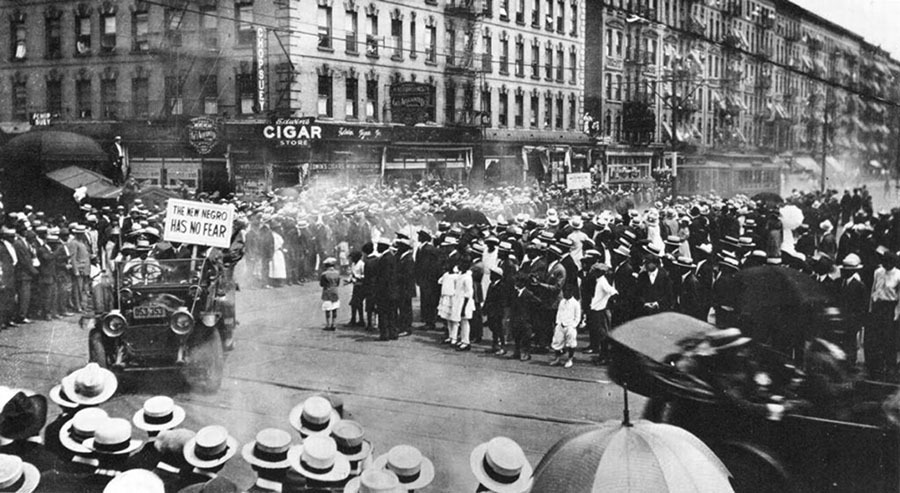
UNIA fully endorsed Garvey’s unique approach to the racial problem. As Garvey himself said in 1921:
“If you want liberty, you yourselves must strike the blow. If you must be free, you must become so through your own effort . . . Until you produce what the white man has produced, you will not be his equal.”
Using his organization and its newspaper, “The Negro World“, Garvey found popular support among the Black population for his idea of freedom through separation.
Unusually—but typically for Garvey—his newspaper refused to feature advertisements for skin-lightening and hair-straightening products, which appeared in all other newspapers directed at Blacks in America. Instead, Garvey urged Blacks to “take the kinks out of your mind, instead of out of your hair.”
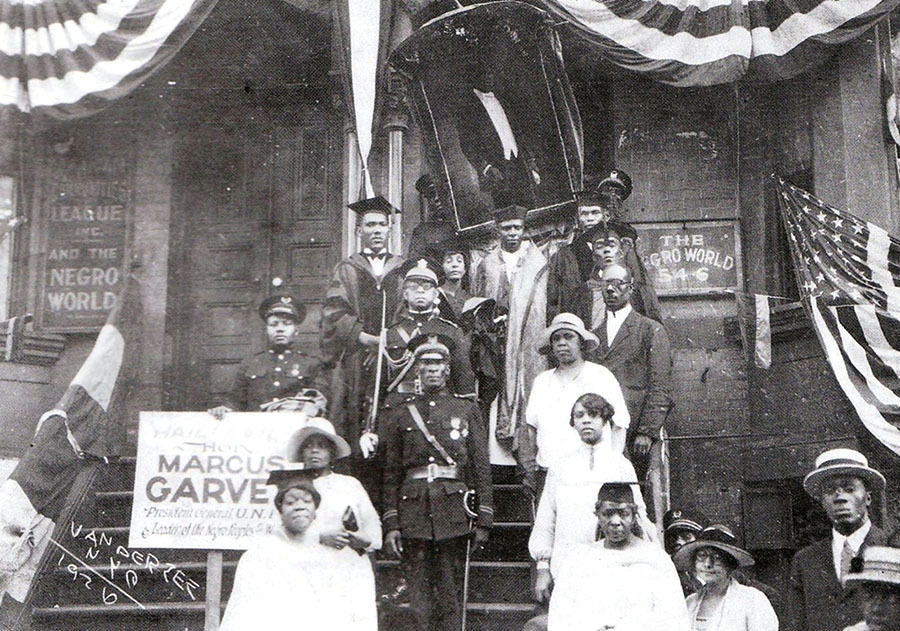
Garvey’s Message Endorsed by Millions
Ultimately, more than four million Blacks joined as signed-up members, all fully endorsing Garvey’s central message, which he summed up as follows:
1. Whites will never believe in racial equality until Blacks have created a society equal to that which the Whites have created.
2. Blacks will never be able to create such a society while living in White people’s nations.
3. Blacks have a right to preserve their racial purity in the same way that Whites and all other races have that same right.
4. Blacks must return to Africa and there build their own nations. In this way, they can claim their rightful place in the world and also ensure their racial purity and unity.
This revolutionary, and for millions of Blacks, inspiring message spread like wildfire, and soon UNIA had chapters all over America, dwarfing those of the NAACP. He was by far the single most popular Black leader of his time, and his message of opposition to racial integration was directly opposed to that of the NAACP.
By 1922, UNIA had attracted the support of America’s first Black pilot, Hubert Fauntleroy Julian, and had officially been given delegate space at the League of Nations. It was a remarkable achievement.
Garvey’s Clash with the NAACP
Garvey’s message continued to find resonance, and his popularity grew, despite W.E.B. Du Bois, the light-skinned mulatto from the NAACP going on record as saying that “Marcus Garvey is the most dangerous enemy of the Negro race in America and in the world.” Du Bois also described Garvey as “a little fat black man, ugly but with intelligent eyes and big head.”
Despite such petty insults, or perhaps because of them, UNIA continued to grow. It became an economically powerful organization and launched a number of economic upliftment programs of its own (the “African Communities’ League” and the “Negro Factories League”), which operated grocery stores and other businesses, including a hotel, a steam laundry, and a publishing house.
Meetings with E.S. Cox and the Klan
By the early 1920s, Garvey had also established contact with E.S. Cox and the “Anglo-Saxon Club” network, based on their joint desire to promote the repatriation program. This began a lifelong friendship between the two men, which resulted in Cox writing extensively about Garvey in his book “Let My People Go” and other works. Cox was the author of many works also advocating the physical geographical separation of the races, the most famous of which was titled “White America.”
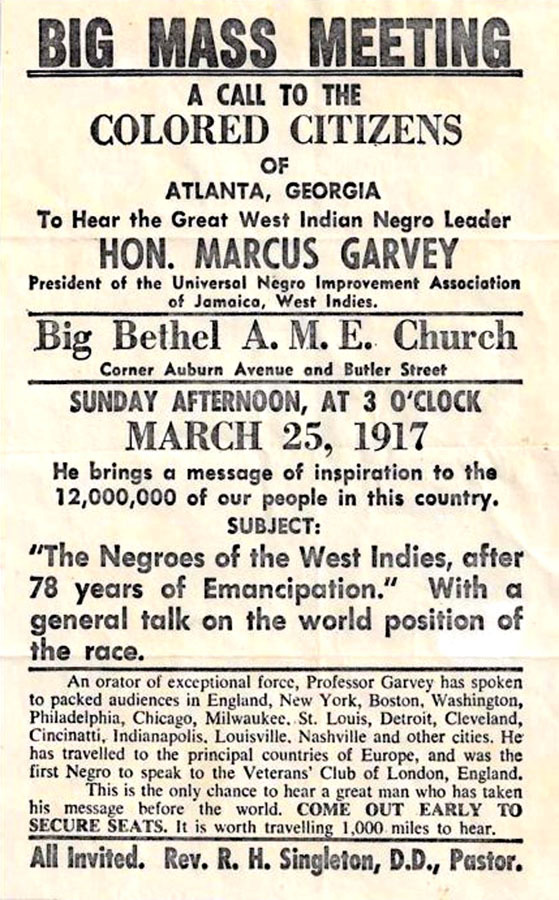
However, Garvey went a step further, and in 1922, while on a tour of the South, met with Edward Young Clarke, the Imperial Wizard of the Ku Klux Klan (KKK), at the Klan’s offices in Atlanta. Garvey said he and that organization shared “similar views” given that he sought a separate state for Blacks. He later defended his links with the KKK and Cox’s Anglo-Saxon Club in public as follows:
“I regard the Klan, the Anglo-Saxon clubs and White American societies, as far as the Negro is concerned, as better friends of the race than all other groups of hypocritical whites put together. I like honesty and fair play. You may call me a Klansman if you will, but, potentially, every white man is a Klansman as far as the Negro in competition with whites socially, economically and politically is concerned, and there is no use lying.” (As quoted in Graves, John L. “The Social Ideas of Marcus Garvey,” The Journal of Negro Education. 31-1: 65–74, 1962.)
The Black Star Line
Another project set up by UNIA was a shipping company, which it called the Black Star Line. Basing its name on the already operating shipping company known as the White Star Line, Garvey intended to operate a fleet of vessels traveling between Africa and the Americas, which would be Black-owned, Black-staffed, and used by Blacks to return to Africa.
To launch the company, Garvey offered shares in his Black Star Line company. By September 1919, the Black Star Line company had gathered $50,000 by selling stock and purchased its first ship, the “SS Yarmouth.” Rechristened the “SS Frederick Douglass” (after the escaped mulatto slave who became famous as an anti-slavery activist in the U.S. North), the vessel was officially launched in October 1919. The “SS Frederick Douglass” was, however, plagued by technical problems and was finally scrapped in 1922.
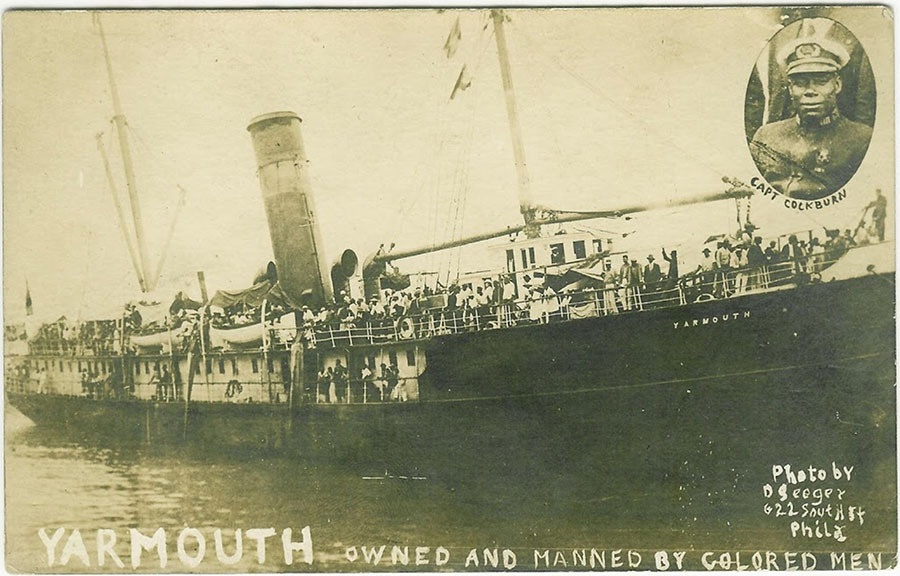
The Black Star Line did not, however, stand still. By 1921, it had acquired another ship, the “SS Antonio Maceo” (named after Lt. General Antonio Maceo, the mulatto second-in-command of the Cuban Army during the Cuban War of Independence). Garvey personally traveled on this ship’s maiden voyage under its new name, going to Jamaica, Costa Rica (where he was met by President Julio Acosta), and Panama.
The Infamous Mailing
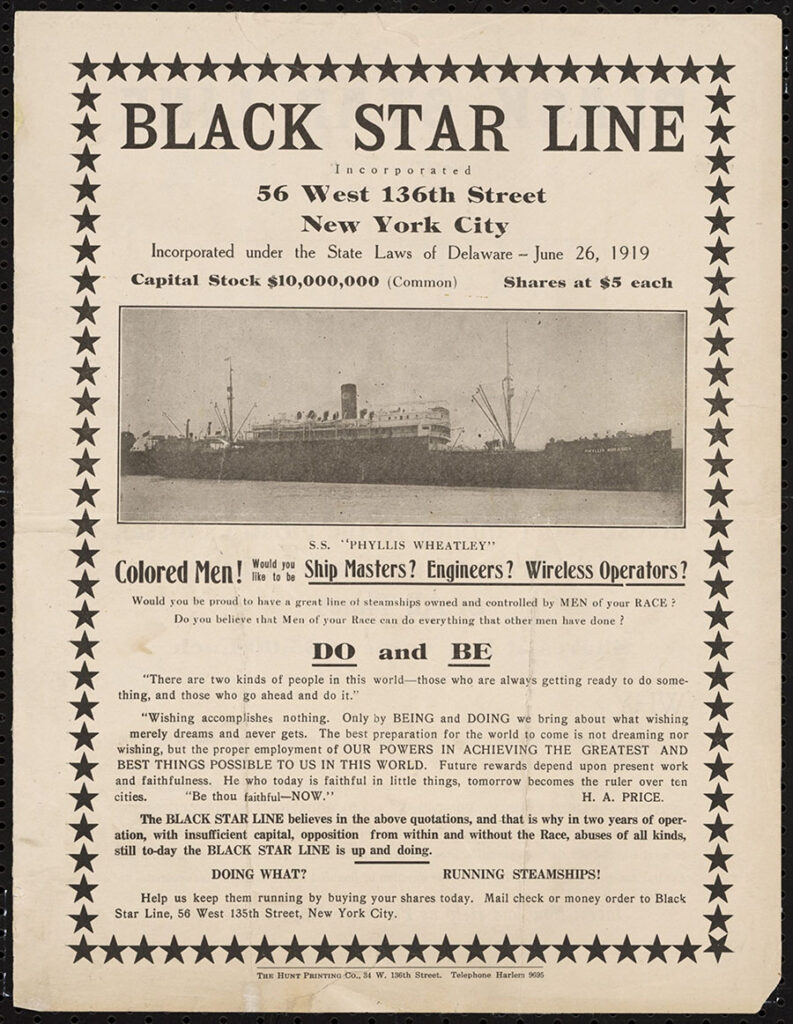
Back in the United States, Garvey then mailed out a brochure advertising the sale of stocks in a ship, the “SS Orion,” which the Black Star Line did not yet own. The SS Orion had been put up for sale by the United States Shipping Board—and the Black Star Line proposed to rename her the “SS Phyllis Wheatley.” “(Phillis Wheatley, c. 1753–1784, was a West African woman who had been kidnapped by another Black tribe and used as a slave before being sold to a passing Trans-Atlantic slaver ship. In America, she entered the service of the Wheatley family of Boston, who taught her to read and write. She later won fame as the first published African poet in North America.)
Garvey’s brochure showed a picture of the “SS Orion,” but called the picture the “SS Phyllis Wheatley.” While there was obviously no direct intent of fraud, Garvey’s enemies in the U.S. Bureau of Investigation (BOI), a precursor to the Federal Bureau of Investigation (FBI), seized upon this technicality—that the ship advertised “did not exist”—and arrested the UNIA leader for the crime of “mail fraud,” that is, using the U.S. Mail to commit fraud.
Although it was clear that the picture on the brochure was being used as an illustration of what the company wanted to buy, the charges were railroaded through the courts, and in 1923, Garvey was found guilty and sentenced to an outrageous penalty of five years in prison.
Garvey Accuses Jews of Railroading him
Garvey was furious with the verdict, shouting abuse in the courtroom and calling both the judge and district attorney “damned dirty Jews,” adding that they had sought revenge against him after his much-publicized meeting with the KKK.
In 1928, Garvey told a journalist: “When they wanted to get me, they had a Jewish judge try me, and a Jewish prosecutor. I would have been freed but two Jews on the jury held out against me ten hours and succeeded in convicting me, whereupon the Jewish judge gave me the maximum penalty.” (“Marcus Garvey Life and Lessons: A Centennial Companion to the Marcus Garvey and Universal Negro Improvement Association Papers,” Marcus Garvey, University of California Press, 1987, p. lvii.)
Jews Behind NAACP
His legal troubles were no coincidence. The NAACP, which was the organization preferred by the Jewish lobby in America at that time to promote racial integration, saw Garvey’s message of racial separation as a direct threat.
The list of Jews behind the NAACP was long and important: the chairman of its board from 1914 to 1919 was the Jewish academic, Joel Spingarn, who also served as the NAACP’s president from 1930 to 1939. It was he who in 1914 established the Spingarn Medal, which is still awarded annually by the NAACP to Black individuals for “outstanding achievement.”
His brother, Arthur Spingarn (1878–1971), was also a key figure in the NAACP, serving as a legal strategist and longtime leader of the organization. As chairman of the NAACP’s Legal Committee, Spingarn would have been one of the leaders spearheading the legal attack upon Garvey, and the exploitation of the minor technicality contained in the Black Star Line mailing. Arthur Spingarn took over as president of the NAACP after his brother’s death in 1939, and held that position until 1965.
Garvey Imprisoned for Mail Fraud
Garvey was eventually released on $5,000 bail while he appealed his conviction but was finally imprisoned in 1925 after the U.S. Court of Appeals turned down his application. Imprisoned in a penitentiary in Atlanta, his supporters immediately started agitating for his release.
By 1927, U.S. Attorney General John Sargent had been presented with a petition containing over 70,000 signatures calling for Marcus Garvey’s release. Sargent then informed President Calvin Coolidge that “Negroes regarded Garvey’s imprisonment as an act of oppression of the race in their efforts in the direction of race progress.” (“Negro with a Hat: The Rise and Fall of Marcus Garvey,” Colin Grant, London: Jonathan Cape, 2008, page 410). Coolidge then ordered Garvey’s sentence to be commuted to expire that year—on the condition that Garvey be immediately deported back to Jamaica.
Deportation and Death
After being released and deported, Garvey re-established a residence in Jamaica, where he founded the People’s Political Party, that nation’s first modern political organization. Elected as a city councilor, he also sought to contest elections in that country with his new party. However, his manifesto, which called for the arrest of corrupt judges, was ruled to be “insulting to the judicial profession,” and he was sentenced to three months’ imprisonment.
Disgusted with this turn of events, Garvey then permanently left Jamaica upon his release and returned to London. There, he continued his activism and coordinated the establishment of the School of African Philosophy in Toronto to train future leaders of the UNIA—which, by then, had more than a thousand chapters worldwide.
Garvey’s work was cut short by his untimely death at the age of 52 in 1940. He was buried in London, but in 1964, he was reburied beneath the Marcus Garvey Memorial in National Heroes Park in Kingston, Jamaica. The ceremony was attended by numerous foreign diplomats and a huge crowd, and his grave is marked by a large monument.
Garvey’s influence has remained strong to the present day, although the current Black Power movement downplays or often ignores his calls for racial separation.
His pardon is therefore a long-overdue gesture and sets right one of the most grievous wrongs committed by the Jewish lobby against genuine Black nationalism in America.
This article is from the May/June 2025 issue of The Barnes Review.