The most widely heard claim of a great “past black civilization” is that of ancient Egypt, because of the existence of a number of black, or “Nubian,” pharaohs.
The facts of the matter are as follows: ancient Egypt was founded in 3300 BC, and the Nubians ruled only for a short period between 732 and 664 BC.
This was more than two thousand years after ancient Egypt had been founded—and, significantly, the black ascendancy to the throne marked the collapse of Egypt, not its foundation.
In reality, the founders of ancient Egypt were of European racial stock. Although blacks and Semites were present in small numbers at the early stages of ancient Egypt’s history, they only featured as trading partners, slaves, or hired mercenaries.
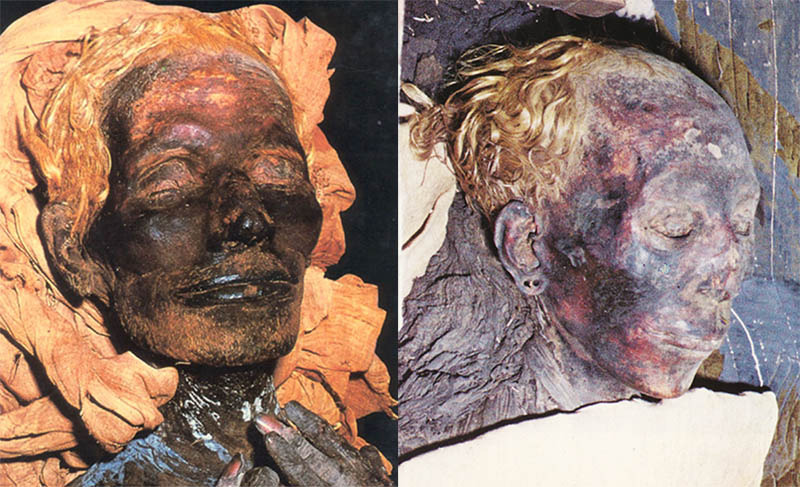
Above, left: Yuya, an Egyptian nobleman from 1400 BC. He was the father of Tiy, the wife of Pharaoh Amenhotep III. Yuya’s blond hair has been well preserved by the embalming process. Alongside, his equally blonde-haired wife, Thuya, great grandmother of Tutankhamen
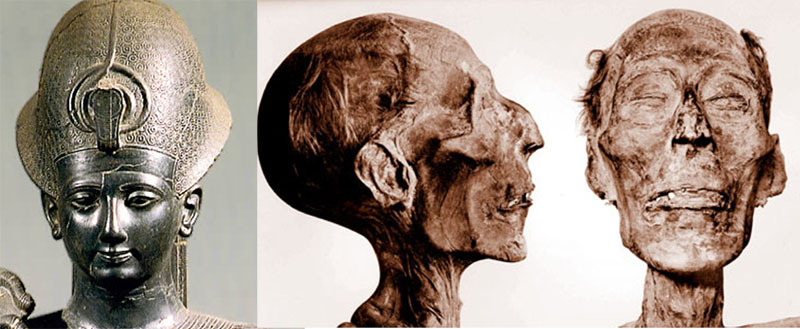
Above: A statue of Ramesses II, nineteenth dynasty (1292–1225 BC), and his mummy.
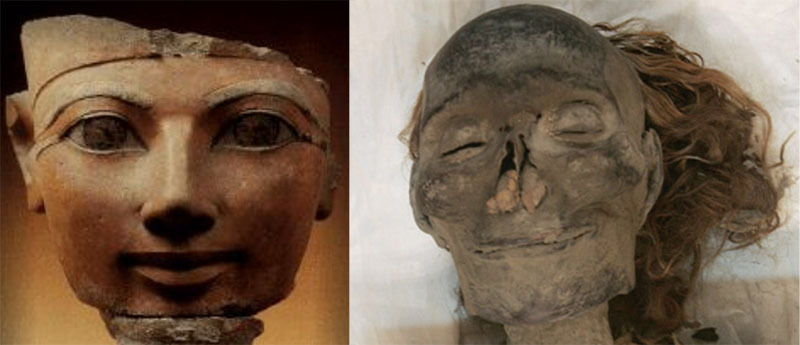
Above: A bust of the female Pharaoh Hatshepsut, fifth pharaoh of the eighteenth dynasty (1509–1458 BC), and her mummy.
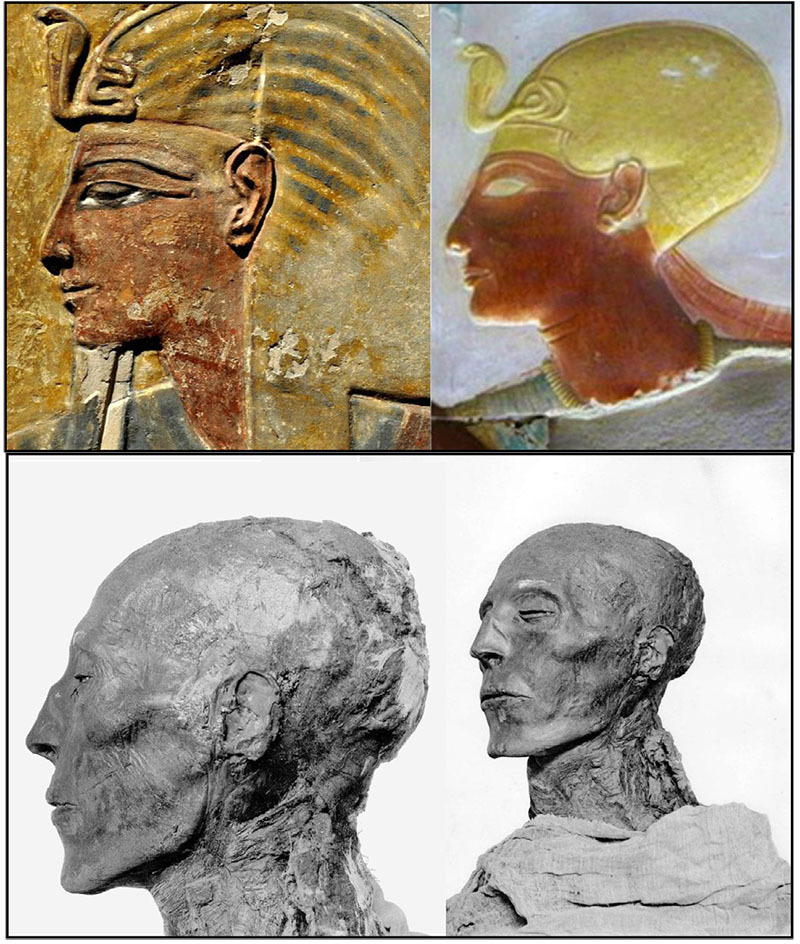
Above: Artwork depicting Pharaoh Seti I, made during his lifetime at the Temple at Abydos, circa 1320 BC, and his mummy.
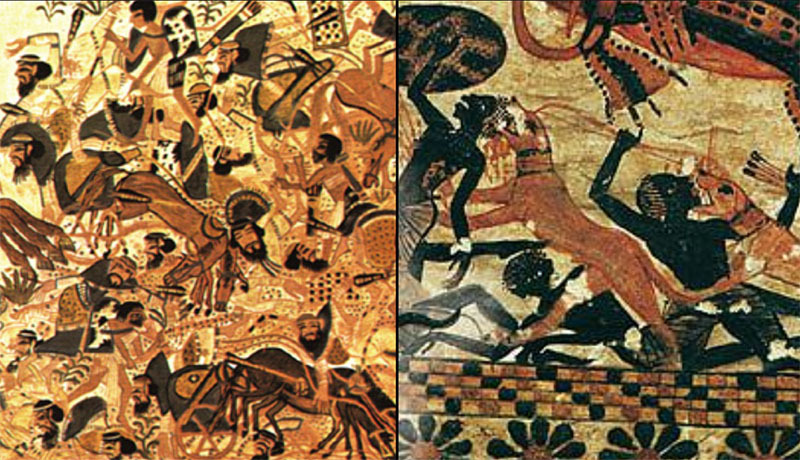
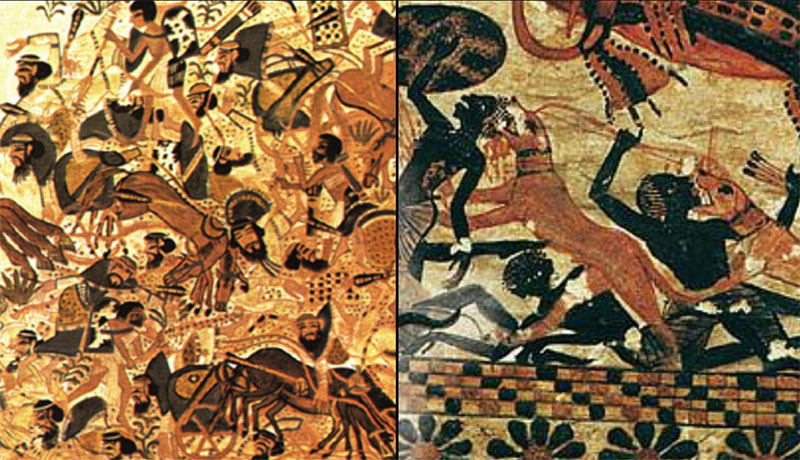
Above: Close-ups of the sides of Tutankhamun’s “Hope Chest” showing Semitic and black enemies being defeated.
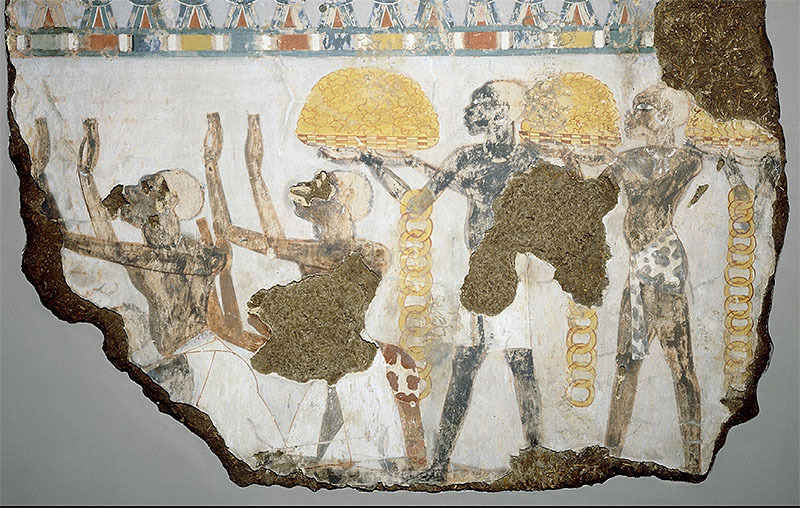
Above: Nubians bringing tribute to the pharaohs, Tomb of Sobekhotep, twelfth dynasty, circa 1850 BC.
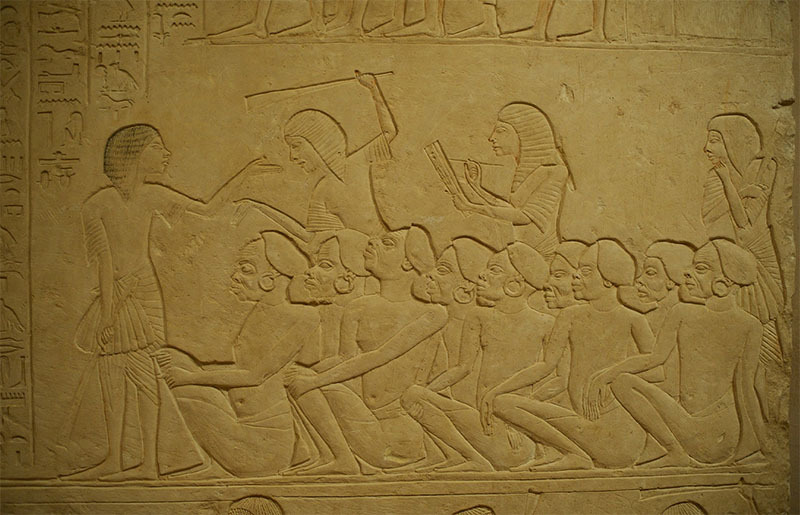
Above: Egyptian slave market, with black slaves waiting to be sold. Bologna Museum.
In addition, the white Egyptians left many written references to the black population in Nubia, and in their own country. The most complete record and translation of these scripts was undertaken by Professor James Henry Breasted, Professor of Egyptology and Oriental History in the University of Chicago in his works History of Egypt, from the Earliest Times to the Persian Conquest, and his Ancient Records of Egypt series.
The ancient Egyptians invaded Nubia several times, and the final conquest of that land was attained by Sesostris III in 1840 BC. As translated by Breasted, the first Semneh stela inscription recounting the subjugation of Nubia by Sesostris III reads as follows:
“Southern boundary, made in the year 8, under the majesty of the king of Upper and Lower Egypt, Sesostris III . . . in order to prevent that any black should cross it, by water or by land, with a ship, or any herds of the blacks; except a black who shall come to do trading in Iken, or with a commission. Every good thing shall be done with them but without allowing a ship of the blacks to pass by Heh, going downstream, forever.”
Because the ancient Egyptians liberally used blacks and Semites as slaves, workers, and even low-level state functionaries, racial integration became widespread and the numbers of mixed-race individuals eventually became overwhelming.
By the time of the twenty-fourth dynasty, about 730 BC, Egypt’s population resembled that of today: a mixed-race mass made up of white, Semitic, and black extraction.
In 727 BC, the Nubian king Piye invaded Egypt and established the twenty-fifth dynasty. This era was the first genuinely black rule in Egypt, and although the twenty-fifth dynasty is counted as part of the historical line of rulers of Egypt, it had no links at all with the earliest kings—and founders—of that civilization.
This Nubian dynasty came to an abrupt end when Egypt was invaded by the Assyrians in 655 BC, only some 72 years later.
The Afrocentrist claim that the handful of black pharaohs from the twenty-fifth dynasty “proves” that ancient Egypt was African in origin is as false as claiming that the United States of America was founded by blacks because it had a half-black president in 2011—or that Detroit was founded by blacks because it has a majority black population in 2015.
In fact, as the historical record shows, the appearance of blacks as “pharaohs” marks the end of ancient Egypt, not its foundation.
It is furthermore unlikely for Africa to have produced any inventions or advances at all, given that the average sub-Saharan African IQ ranges between 60 and 80. According to the internationally-accepted Sanford Binet intelligence scale, an IQ of 80 to 89 is regarded as “dull.”
Finally, as pointed out in the book Race by Oxford University’s Professor John Baker, the wheel was unknown in sub-Saharan Africa even in the mid-1800s. Baker quotes the explorer Dr. David Livingstone’s diaries which describe the Africans in the village of Linyanti, in present-day Namibia, as turning out in their thousands to see his “vehicles in motion and thus for the first time to observe the rotation of a wheel” (Chapter 19: The Negrids II. Foreign influences on culture, Race, Prof. John Baker).
To believe that a people who, only 170 years ago, did not have the wheel, could produce ancient civilizations and invent modern machinery, beggars belief.