Sometimes Christians forget just how widespread the Prince of Peace’s following was before Islam.
By Ronald L. Ray. Most people—in fact, most Christians—tend to think of Europe and the regions the nations of that continent conquered, when they think of the history of Christianity. Many may even be aware of “Eastern Christianity” but typically associate it with either Greece or Russia.
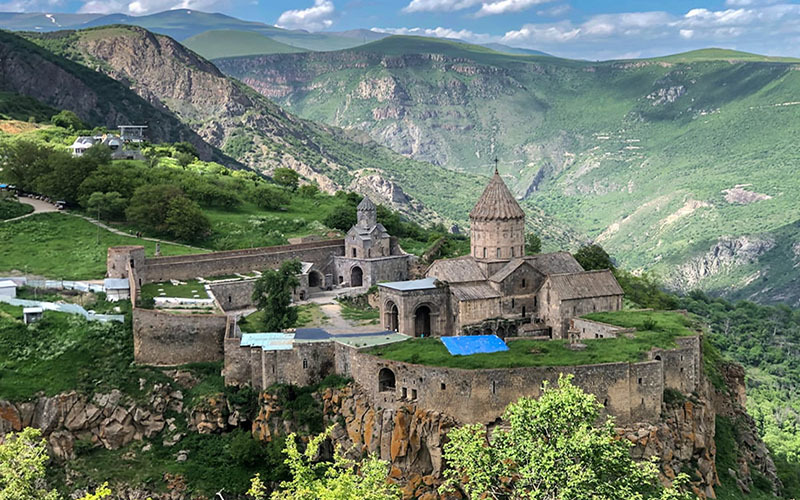
In A.D. 301, Armenia became the first major country to recognize Christianity as a state religion. The Tatev monastery,
shown here, is one of the pearls of old Armenia. Construction of the Christian complex, on the site of an older polytheistic
temple, began in the 9th century. By the 11th century, the Tatev monastery housed around 1,000 monks and a large number
of artisans. In 1044, Muslims destroyed the Church of St. Gregory at the site, along with surrounding buildings. They
were soon reconstructed. The monastery was significantly damaged during the Seljuk Turkish invasions of the 12th century
and by an earthquake in 1136. In 1170, Seljuks plundered the monastery and burnt something like 10,000 manuscripts.
The monastery was rebuilt toward the end of the 12th century.
There is, however, an entire non-European Christian world, which once extended across most of Asia and now survives—perhaps not much longer—as tiny remnants here and there, where once, before Islam, there were millions of faithful adherents. This is a brief overview of those “forgotten Christians” and what happened to them.
Read the entire article in PDF format here.
Taken from The Barnes Review, March/April 2016: Jihad! Islam & the West: Can We Co-exist? VOLUME XXII, NUMBER 2