Those who want to know more about Adolf Hitler should take a gander at this authorized biography
By Mark Roland. There are more books about Adolf Hitler than any other historical figure. Eighty years after his death, the world’s largest publishing companies continue to churn out biography after biography, each claiming fresh insights into his life and personality.
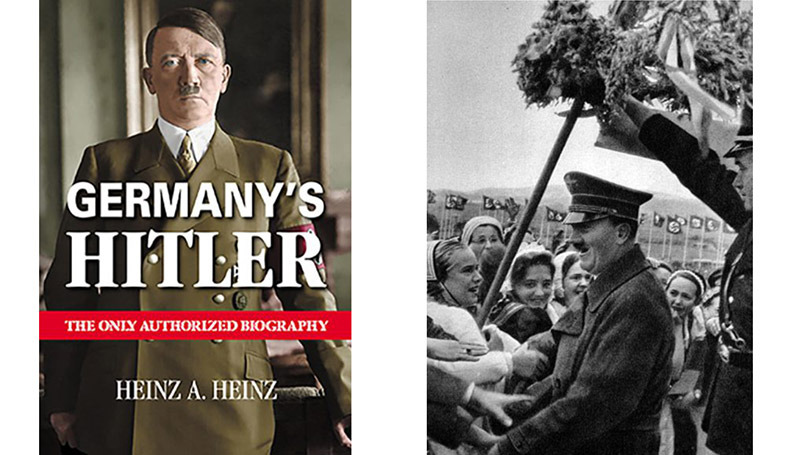
However, the only things new they occasionally offer are ever more preposterous calumnies amid the same rehash of official, uniformly negative narratives repeated unchanged since 1945. If you have read one, you’ve read them all.
Lost amid this immense, if consistently biased library of unrelieved hatred in print, is one volume reissued by a non-conformist publisher of the Führer’s only authorized biography.
As such, it provides invaluable source material today’s Court Historians are afraid to cite for its myth-busting potential. Originally appearing in 1934 and rereleased in an updated edition four years later, the book was specifically dedicated to English-speaking readers in Britain and America, then being incited to war against their racial brothers and sisters in the Third Reich.
Back then, as an honest voice crying in a wilderness of lies, whatever Germany’s Hitler had to say was shouted down but has since become more vital than ever, as an effective antidote to four generations of deceit.
Contrary to the usual critics’ expectation, it is not a propaganda panegyric to Adolf Hitler but introduces him instead as a flesh-and-blood human being divested of the slanders that distorted and still conceal his true identity.
To do so, Heinz A. Heinz interviewed Hitler’s old classmates, army buddies, fellow working men, landlords, and early party comrades, and even his jailer. They divulged revealing, often everyday scraps of information which, in the aggregate, present a credible, real-life portrait found in none of the other thousands of malevolent tomes.
It is, therefore, especially threatening to consensus writers whose careers absolutely depend on the uncritical depiction of Hitler as the most cruel, inhumane creature the world has ever known. This kosher caricature, for all its ubiquitous big-money publication, is nonetheless vulnerable to the pinpricks of simple truth presented in Heinz’s book.
He tells, for example, how:
In a village in the neighborhood of the Obersalzburg [located about 75 miles southeast of Munich, the site of Hitler’s former mountain residence], there lives a boy who suffers from paralysis. He once wrote to Adolf Hitler and asked for a wireless set as a Christmas present. The letter found its way into the Führer’s hands, and, to the great surprise and joy of the poor youngster, the Führer insisted on making him a personal present of the much desired set.
This Yuletide gift gave Hitler an idea he immediately transformed into reality. He ordered the Hitler Youth organization to institute a special subgroup that supplied wireless sets and special education in their use, both free of charge, to handicapped German children in economic need. A medical study issued just three months later reported chronic depression and suicide rates for juveniles aged nine-to-15 years old had since abruptly fallen to their lowest levels ever recorded, especially among the blind, many of whom went on to excel as telegraph operators.
Encouraged by these results, Hitler ordained that musical instruction and special access to musical instruments must also be made available to financially strapped, handicapped children, again at his government’s own expense.
The brilliant success of these social programs was eventually broadened to embrace all lower-class, physically disadvantaged Germans, regardless of age. In time, bands and even whole orchestras of handicapped performers became public fixtures of the Third Reich. As a consequence, general standards of emotional health saw significant improvement. “We help those who help themselves,” Hitler explained, “thereby raising our whole racial community”—“Volksgemeinschaft.”
His people were not without gratitude. Heinz writes:
On average, 3,000 letters reach the Chancellor’s office every day, each of them addressed to Adolf Hitler personally, from all parts of the country. A special bureau deals with these letters alone, and it has been ascertained the great majority of the requests received are, in point of fact, justified. In such cases, help is always given, either by the National Socialist People’s Welfare Organization [“Nationalsozialistische Volkswohlfahrt,” NSV], or by some other organization of the Party [the brownshirted Stormtroops and black-shirt SS both operated social relief chapters in every city and most towns], or by the Reich Chancellor himself. He frequently causes such letters to be laid before him, with a view of keeping in constant touch with the anxieties of the people and in order to lend a helping hand himself. During the weeks preceding Christmas, the stream of letters grows to the dimensions of a flood. Tens of thousands of children write to “Uncle Hitler” to tell him about their Christmas wishes. They believe he must surely be on good terms with St. Nicholas, and in this they are right.
The postal deluge repeated itself in early spring:
Every year, on his birthday, Hitler receives more presents than it has ever been the lot of a statesman to receive from his fellow countrymen. Every year, on April 20, entire post office vans drive up to the Chancellor’s residence, and whole rooms gradually fill with presents of every description. The great majority come from humble homes and also from children, and many of the presents represent months of patient work. It is with the greatest happiness the Führer examines all the presents which are sent to him.
We may find it difficult to imagine any politician in the world today—especially any American politician—celebrated with equal fervor by his own people.
Unlike U.S. congressmen best known for voting themselves pay raises at every opportunity, Hitler gave all his regular government money away:
His official salary is wholly diverted for the relief of poverty and unemployment. He accepts no income from his chancellorship, but directs this money should go to the relief of the jobless. It may not be equally unknown, during the winter of 1933–34, when the sales of his book had reached their peak, the whole of this increment was also earmarked for the poor.
Hitler had no personal financial investments of any kind—no stocks or bonds, no annuities, no properties, no bank loans, no interest-bearing accounts, no regular income, nothing but sporadic royalties from the sales of Mein Kampf which, as just mentioned, he more often than not donated to various social causes.
Hitler was the rarest thing in the world: a man who could not be bought. That explains why his enemies had to kill him and also explains why they continuously flood the public with books and movies vilifying him. To them, everyone has a price. Because he did not, they were angered and horrified he was beyond their control.
How could such an anomalous personality have come to be? Was he born that way? If not, what forces shaped this very different sort of man?
The first was undoubtedly his mother, Klara. Her unconditional love for her children was exemplified by cheerful if untiring selflessness on their behalf. It was this joyful, constant service toward the well-being of her family that most deeply engrained Adolf from early youth, and beyond into adulthood, when he transposed the motherly altruism with which she nurtured him onto the whole German people. It was from this fundamental compassion his benevolent social programs sprang.
Later, when Hitler became chancellor, he named a street after his mother in Passau, a city in Lower Bavaria, where she and her little family lived happily from 1892 until 1894.
The next formative influence of his life set in after her death in 1907. Over the next seven years, he completed approximately 360 sketches and watercolors of mostly outdoor scenes and—after his move to Vienna, then Munich—churches and monuments.
The close attention to detail required by the execution of these images instilled in him a profound appreciation of Germany’s natural beauty and the greatness of that old nation’s high culture, a recognition from which arose a patriotic passion, as ever-growing as it was heartfelt.
All his artworks shine with that bright love of country. They graphically contradict hostile portrayals of a dark, misanthropic soul seething with deep resentment and paranoid hatred. That characterization instead belongs to self-evidently psychotic expressions of nightmarish imagery conceptualized by personalities like Pablo Picasso or Marc Chagall.
To supplement the inadequate income Hitler made by peddling his paintings on city street corners, he resorted to part-time employment as a day laborer, a lowly condition that nonetheless acquainted him all too well with the miserable existence of working-class fellow countrymen.
Time spent in this proletarian “School of Hard Knocks” personally educated him about their virtually hopeless dilemma, which he would later rectify by raising Germany’s standard of living to the highest in all Europe, even in the face of the Great Depression which ravaged the rest of the world.
The final influence of his life was World War I. The consistent heroism and steadfast comradeship of the so-called “common man” Hitler witnessed during four years of trenches flooded with storm water and blood inspired him with the idea to rebuild their shattered nation on these same, high qualities.
But the odds of survival seemed impossible. “Of the three thousand men in the Regiment List,” in which Hitler served, “only 500 came safely out of it. The rest were killed or wounded.” One of his fellow dispatch runners recalled a typical British attack in early September 1915:
The air was full of screaming shells and the hideous hissing and crashing of the “whiz-bangs” [antipersonnel explosives]. Suddenly, our company officer discovered telephone communications with the next section had broken down, and Hitler and another man got the order to go and find out what was wrong. They made it, somehow, but got back only by the skin of their teeth, utterly done in. The wire had been cut. An attack in force was imminent. Warnings must be sent further afield. Hitler received the order a second time. It was nothing less than a miracle how he escaped with his life. It was literally raining shells. The attack, however, failed. How we withstood it, I cannot tell.
Worse was to come, according to the same dispatch runner:
I shall never forget the night of September 15 as long as I live. It was an inferno of fire. All our field telephones were out of order again, and we message carriers were on the go incessantly, our lives at stake every moment. We were opposed by Australians. They came on over and over again. Hitler and another courier got the order. He and his comrade set off in the face of almost certain death, peppered with shot and shell every yard of the way. Half the time they were cowering for shelter in shell holes and ditches. They were wet through and half-frozen. Hitler’s companion gave out. Buckled right up, unable to stick it another step. Hitler hoisted him along, somehow, rather than leave him to his fate, and the two of them came at last, God only knows how, back at the dug-out.
These were par-for-the-course battles on the Western Front from 1914 until 1918. For his participation in so many of them, Hitler’s superior officers valued him highly.
On September 17, 1917, they gave him the Military Service Cross with swords; on May 9, 1918, he got the regimental diploma for signal bravery in attack; and, on August 4, 1918, he received the Iron Cross first class.
The Iron Cross First Class was not given to lance corporals, save for exceptional and repeated acts of courage. This award made him eligible for application to officer training, which would have allowed him to be excused from duty for the rest of the war, safely away from the fighting in a clean environment with good food.
Max Amann, formerly regimental clerk, tells us, “Hitler never wanted a commission. He’d joined up in the ranks, and in the ranks he wanted to remain.” Another comrade recalled, “Hitler then was a nobody like the rest of us. Nothing but a man in the trenches.”
Enemy-inspired assertions assailing him as a draft-dodger only began with the onset of his notoriety in 1920. The same accusation is repeated today, such as this line from the chapter on Hitler’s early years in the “U.S. Holocaust Musuem’s “Holocaust Encyclopedia: “Hitler moved to Munich, Germany, in May 1913. He did so to avoid arrest for evading his military service obligation to Habsburg Austria.”
This distortion was debunked as long ago as the pre-World War II publication of Heinz’s book:
One of the gibes leveled by his opponents at the Führer is that he was a “deserter” from the Austrian army, otherwise how came it that he volunteered in Bavaria? The sufficient answer to this calumny is contained in a document issuing from Austria itself. It states Adolf Hitler duly reported himself to the military authorities at Salzburg, on February 5, 1914, but that he was found to be “unfit” for military service.
An ironic, little-known incident during the immediate postwar period elucidates his transformation from common soldier to political activist. In the wake of Imperial Germany’s surrender and the subsequent chaos spreading throughout society, Hitler was having lunch with some army buddies in a public restaurant, when conservatives of the Free Corps, then battling a Bolshevik attempt to seize Bavaria, showed up:
They took every man in the place, including Hitler, prisoner, and shut them up in the cellars of the Max Gymnasium [in Munich]. A few days later, however, an officer who had been at the front, happened to come along and spotted Hitler among the prisoners. “Why, how’s this?,” he demanded. “You’re no communist!,” and had him immediately set free.
Upon his release, Hitler was promoted to regimental instructor. Heinz tells us:
He discovered his own gift for public speaking and exposition. He rather imagined he had such a talent, but these classes in barracks were useful enough to exercise and prove it. As a matter of fact, this military duty gave him the key to his own future. He decided to leave the army and go in for politics altogether.
By then, Jewish power over a prostrate Germany was not the disguised affair it hid behind in other Gentile nations. It was blatant, and no one denied it. Heinz says:
The Communist Central Office in Berlin [Lenin himself] sent the Jew Levine [Eugen Levine, leader of the Second Bavarian Soviet Republic], a man of their own, to Munich, and, on the night of April 17, 1919, a Red assembly was held in the Wittelsbach Palace, which inaugurated the brief Red regime with yet another Jew, Ernst Toler, at its head.
The Communist Party of Germany Levine served was under its founder, Paul Levi. He opposed another Jew, Kurt Eisner, then in control of the liberal Independent Social Democratic Party. Heinz writes of:
… severe strikes in the Ruhr inspired by communist leader Karl Liebknecht [together with Rosa Luxemburg]. Munich and the southern half of the country [was] in the hands of the Bolsheviks, who sought to link it up with the Hungary of Bela Kun [born Béla Kohn] and aunt, Maria Alexandrovna Blank].
To enable this splintering of Germany into Soviet states, Bavaria’s Red Army numbered over 20,000 troops. In opposition to these catastrophic conditions, Hitler’s counter-revolutionary ideology needed hardly more than three years to transform its original seven-member group into a mass movement that made its first bid for power on November 9, 1923. With its failure in the streets of Munich, Hitler, painfully wounded with a broken shoulder, was arrested. The soldiers who opened fire on his demonstration were not, however, Jewish communists but German conservatives, who despised him as much as they hated Lenin, if not more so.
Twenty-one years later, they would try to kill him again in their July 20, 1944 bomb-plot at his Wehrmacht headquarters in East Prussia, with many an attempted coup de grâce during the decades between.
For now, they were the primary powers-that be ruling Bavaria, where Hitler’s trial on charges of high treason presented them with a dilemma. A death penalty or even lengthy incarceration would make him a public martyr, empowering the very phenomenon he created and they deplored.
The National Socialist German Workers Party (NSDAP) had won wide spread popular support and sympathy, and was a political entity worth harnessing for its own agendas. To make over its stormtroopers into useful cannon fodder against Bolshevik uprisings, Hitler needed to be controlled.
After serving nine months of a five year prison sentence, he was paroled on December 19, 1924, on the condition NSDAP activists strictly adhere to federal government regulations. Hitler agreed, knowing full well the watchful authorities would send him back behind bars for a much longer term if he gave them the slightest excuse to prosecute him once more.
Confirming conservative fears, “an incredible number of letters, telegrams and parcels arrived for our most important prisoner that morning.” Hitler arrived at Landsberg Prison, remembered Warden Franz Hemmrich:
He gave away the contents of parcels sent to him, and always contrived, if possible, to have something on hand for the children of anyone who came to see him.
Sharing his confinement were several dozen other veterans of November 9 who had been arrested and found guilty for their participation. Heinz says:
He was always at their command to be of help or service. As a rule, he was singularly cheerful, and did his best to make their evenings go with a swing. He even got Hess [Rudolf Hess, likewise imprisoned for his role in the Munich Putsch] to make out a list of their birthdays, so whenever one of these came round, the individual in question would be specially invited to coffee with him in his room, and they’d sit and talk, and Hitler would dish up some little present or other. He never made any distinction of persons. He’d offer a peasant who came to see him his own chair to sit on, as readily as he’d offer it to a general.
When the day of Hitler’s release finally arrived, the Warden recalled:
He took cordial farewell of his companions, and then, turning to me, shook me by the hand and thanked me for what I had done for him, though I am at a loss to know exactly what this might have amounted to. A moment after, he had gone.
Otto Leybold, a high-ranking Bavarian official, joined Hemmrich at the prison gate to see the car that came to fetch their most controversial inmate. He recalled:
The governor himself turned to me, as Hitler drove away, and remarked, “Well, if it’s anyway possible to uplift this country again and set her on her feet, that’s the man to do it.”
This article originally appeared in The Barnes Review, March/April 2025. To find out what else you are missing, subscribe to The Barnes Review today.