The Barnes Review
A JOURNAL OF POLITICALLY INCORRECT HISTORY
March/April 2026 ❖ Volume XXXII ❖ Number 2
TABLE OF CONTENTS
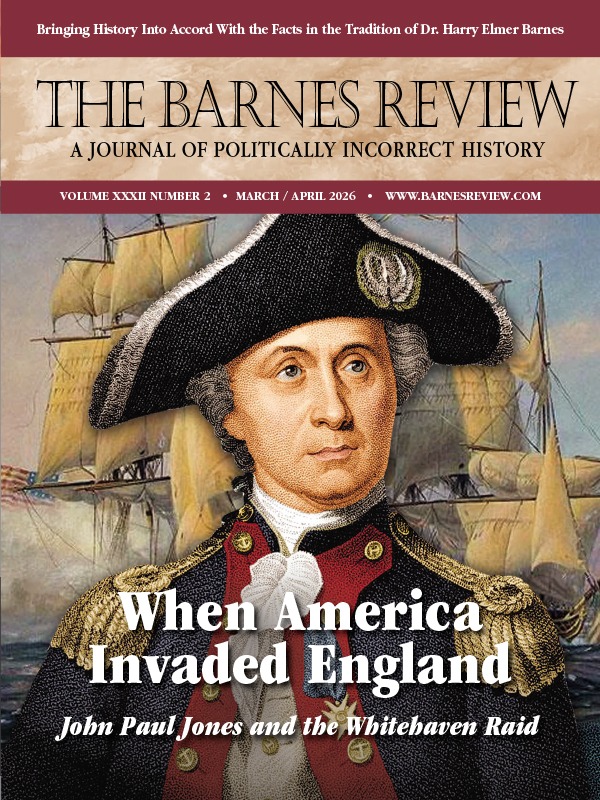
WHEN AMERICA INVADED ENGLAND: THE WHITEHAVEN RAID
By Thomas Redfern In 1778, the fledgling American republic was in dire straits. The combined, massive land and naval power of the British Empire was proving too much for the Colonial rebels. But one man had a plan. Father of the American Navy John Paul Jones proposed that the best way to get the noose off the American neck in North America was to strike England on her home turf. His daring plan, at first rejected, was finally approved, and Jones began preparing for a surprise attack on the port of Whitehaven, England, where British coal tenders and merchant ships provided a tempting target …
PUTIN’S ENDLESS WWII LIES
By Arthur Kemp. While TBR respects Russian President Vladimir Putin for his defense of Western and Christian tradition and culture, listening to the man talk about World War II is infuriating. In his view, the “Great Patriotic War” was all about defeating Nazism. (He even used this excuse to invade Ukraine.) In WWII, according to Putin, the Russians were the saviors of Europe, bravely resisting the Nazi scourge, sacrificing millions to this “noble cause.” Putin knows history, so he knows he is lying. In fact, without indispensable help from the USSR, Germany’s post-World War I resurgence might very well have flopped. Putin also knows that Hitler’s Germany was far less a danger to Europe than Russia’s “stainless” hordes. Here are the facts..
BOLSHEVISM AND COMMUNISM VERSUS RUSSIAN ORTHODOXY
By Matthew Raphael Johnson, PH.D. Many times the Russian Civil War (1917–1922) is framed as nothing more than a conflict between two political forms—tzarism and Bolshevism. In fact, the stakes were much higher. The conflict could more accurately be described as a battle to the death between the godless, anti-Christian forces of Trotsky and Lenin versus the Russian Orthodox Church. Here, Dr. Matthew Johnson explains the religious and social elements of the Russian Civil War.
THE REAL NUCLEAR ROGUE STATE
By Arthur Kemp. Currently, President Donald Trump is sending a massive U.S. naval armada, including multiple modern aircraft carriers, and parking it in Middle East waters. Why? Because Israel has convinced him that Iran must be destroyed as it is allegedly “mere seconds away” from building its own nuclear bomb. According to U.S. intelligence agencies and global nuclear watchdogs, this is a blatant lie. In fact, it is Israel that is by far the world’s worst “rogue nuclear power,” as TBR explains in detail. .
TESTAMENT OF A RUSSIAN FASCIST
By Remi Tremblay. Fascism and Russia are two words you rarely hear together. Bu in the mid-1920s, there was a growing Russian fascist movement inside Russia and abroad. One of these Russian fascists, Konstantin Rodzaevsky—as an eye witness—had much to say about the Red Terror, Judeo-Bolshevism, and his hatred for the Reds..
RESEARCHER SAYS EDWIN STANTON BEHIND LINCOLN MURDER PLOT
By Marc Roland. Over the decades, TBR has presented articles discussing the assassination of Abraham Lincoln. One thing we’ve learned is that it was, like the John F. Kennedy slaying, most likely a vast conspiracy involving many disparate players with various motives. Stolen diary pages, a poorly guarded escape route, an AWOL body guard, a religious zealot, a poisoned spymaster: Who was pulling all the strings?
EXPLORER PAUL DU CHAILLU’S ADVENTURES IN AFRICAS
By Mike Mains. In recent issues of TBR, you’ve heard mention of intrepid French explorer Paul du Chaillu, the first White man to verify the existence of gorillas and to interact with a tribe of pygmies—thought to be nothing more than a myth before his on-site reportage. In this issue, TBR offers several exciting vignettes taken from du Chaillu’s first book, Lost in the Jungle.
Features:
Personal from the Editor ● Editorial: Brave Lady Selkirk’s Silverware ● Jones Spikes the British Cannon ● A Meeting of Allies ● A Prominent Revolutionary ● History You May Have Missed ● Martyred for Resisting the Reds ● Letters to the Editor
From The Barnes Review, March/April 2026
A MOST UNLIKELY VICTORY
When you really think about it, the American victory over the British during the Revolutionary War was an unmitigated miracle from the moment the first shots of the war were fired on April 19, 1775, at Lexington Green to the stacking of arms by British regulars at Yorktown on October 19, 1781. What inspired these 77 Minutemen to stand and fight toe-to-toe with several hundred well-armed and well-trained British soldiers? Those British soldiers were coming to confiscate their guns.
In 1776, the combined might of the British military had even major European powers quivering. At the time, the British Royal Navy was composed of 270 warships, but by the end of the war, that number had grown to 500. Some of them had as many as 60 cannon. When the Crown feared New York might be lost to the rebels, George III authorized an expeditionary force to be ferried across the Atlantic. That English naval armada alone included 30 warships and more than 300 trans port vessels and supply ships.
By comparison, the embryonic American Continental Navy could muster but 27 ships. Luckily, men like John Paul Jones knew how best to employ the few vessels America had available, launching daring raids on enemy merchant shipping, warships and even ports the British believed were impervious to American attack.
Then, of course, there were the British infantry, cavalry and artillery. According to historians, the “British army establishment” in the Colonies was made up of approximately 55,000 men. Of these, 25,000–30,000 were “Redcoats,” professional soldiers whose average age was 27–30 years old and who each had an estimated 5 to 15 years of actual combat experience.
But that’s not all. An estimated 30,000 Hessian mercenaries were hired by Britain to fight in the war. In addition, in 1779, at the height of the conflict, uni formed Loyalist forces nearly matched the maximum size of the Continental Army. There were also approximately 25,000 men who fought for various “Provincial Units,” and another 8,000–12,000 slaves who fought for the Brits.
In contrast, the Continental Army could never claim even 50,000 soldiers at any one time. According to historians at the National Museum of the United States Army: From 1775 until the Revolutionary War’s end in 1783 … no more than 48,000 men served [in the Continental Army] at any one time, and no more than 13,000 were deployed in any one place.
The Continentals could, at times, rely on local militias and backwoods men, who might show up unannounced, like at the Battle of Kings Mountain.
In the end, it is estimated that 6,800 Americans were killed in action, 6,100 were wounded, and upwards of 20,000 were captured; 12,000 of them died as POWs. An additional 17,000 deaths were caused by disease—the largest killer of Americans in the war.
And, while the troops of George III were very experienced veterans, the average age of a Continental Army soldier was 16, with some as young as 12. The average military experience of this teenage army was nil—hardly a match for the battle-tested Redcoats.
But the Americans somehow won. A miracle it was. Along the way, there were a string of improbable victories, crushing defeats, and strokes of pure luck that made many believe the American cause was blessed by the hand of God Almighty Himself. There also emerged many fascinating side stories we hear little about:
• The invention of invisible ink by John Jay for spy-craft purposes.
• The first forced inoculations of Americans. In the winter of 1777, Gen. George Washington mandated smallpox “vaccinations” be given in secret to all of his troops.
• The first use of a submarine in warfare. The attempt by the Turtle to attach an explosive device to a British warship in New York Harbor failed. The ingenious little sub was scuttled to prevent it from falling into the hands of the British.
• A little-known plot to kill George Washington. It turns out that Thomas Hickey, Washington’s own bodyguard, was behind the scheme to murder the general when the commander-in-chief arrived in New York to prepare for an impending British attack. The plot had the backing of the governor of New York and the New York City mayor. Hickey was the only one executed, as it was believed he was the one who would carry out the foul deed.
• The extent of secret French aid to the Americans. It turns out that the French were supplying the American rebels with large amounts of vital supplies, ammunition, weapons, and cash, starting as early as 1776.
Those are just several of the scores of rarely told stories regarding one of the most unlikely underdog military victories in world history. There are many more tidbits, and we hope to delve into some of them in the coming year in the pages of TBR.
So, that’s how it all began, and, 250 years later, I doubt that few, if any, of the 56 delegates to the Continental Congress who signed the Declaration of Independence would recognize America in its current incarnation. The same could be said of those who voted to adopt the U.S. Constitution.
Today, unfortunately, we are led by a gaggle of self-indulgent, greedy politicians on both sides of the aisle, very few of whom, I believe, would have had the courage, tenacity, and selflessness required to repeat what our forefathers did 250 years ago.
Thus, we will not celebrate them this year, but instead will remember those brave Americans who could smell the sweet scent of liberty, dreamt of a life without the yoke of a tyrant hanging around their necks—and were willing to fight and die for it. ❖ —PAUL ANGEL, EXECUTIVE EDITOR.