By Mary Grabar. The myths about Franklin Delano Roosevelt live on. For the left, FDR was a champion of the working class and the oppressed, suffering abuse as a “traitor to his class.” He gave up the lifestyle of the Hudson River gentry to lead his country out of the Depression and to victory against fascism.
For many on the right, FDR was out of his depth on economics but provided Americans with the optimism and confidence necessary to prevail during the Depression and gain victory in WWII.
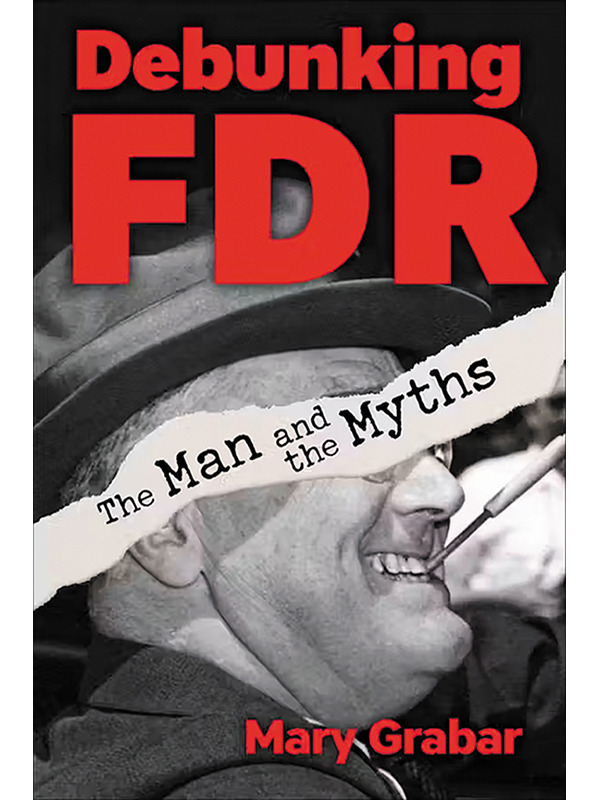
“Debunking FDR: The Man and the Myths” exposes the suppressed and distorted facts about FDR’s life and the legends about him (many invented by FDR himself) promoted by generations of Court Historians.
Born into immense wealth and insulated from the struggles of everyday Americans, FDR’s young life was one of vast privilege and mediocre talent.
Researcher and biographer Mary Grabar chronicles FDR’s path to the presidency: his second-rate studies at Harvard, his indifference to law school and the legal profession, and his steady rise through the ranks of state and federal government.
Here are some of the key myths Grabar aims to expose:
• FDR as a man of the people: The book argues against the idea that Roosevelt was a humble, reluctant leader who prioritized the working class and the oppressed. Instead, it presents him as a “scheming, self-promoting politician faithful to his class and vain about his lineage” who viewed ordinary Americans with disdain.FDR as a champion of civil liberties: The book alleges that Roosevelt had a poor record on civil liberties, citing government actions such as prosecuting individuals who opposed his foreign interventionism and censoring the press.
• FDR as some kind of economic wizard: While some credit FDR with guiding Americans through the Depression, the book suggests he was no financial genius. It also questions the effectiveness of the New Deal in solving the crisis, arguing that it may actually have prolonged it.
• FDR as a reluctant candidate: Contrary to the portrayal of Roosevelt as being drafted into the presidency by popular demand, the book depicts FDR as a power-hungry, disingenuous, and scheming politician.
• FDR as an opponent of racism and segregation: The book accuses FDR of prioritizing his “racist Southern base” by maintaining a segregated military throughout WWII, and opposing federal laws against lynching. He is also alleged to have snubbed Black Olympians (something of which Adolf Hitler was accused) and enforced racial housing segregation, truths at odds with academia’s carefully crafted liberal persona of FDR.
• FDR as a friend to the downtrodden: The book criticizes Roosevelt’s response to “the Holocaust,” accusing him of preventing Jewish refugees from entering America and increasing suffering. (The author is woefully undereducated on the subject of the Holocaust, but she does open up a debate about FDR’s true character.)
In essence, Debunking FDR challenges the heroic image of FDR often presented in laudatory historical accounts and portrays him, instead, as a fatally flawed figure whose policies and personal actions were rarely aligned with the common good.
Hardback, 384 pages, #1068, $35 minus 10% for TBR subscribers.