The latest claims currently circulating in the controlled media about a “new analysis” of Adolf Hitler’s DNA, and of a number of diseases and disorders from which he allegedly suffered, are yet another easily disproved set of weak lies based on hysteria, lies, and ignorance.
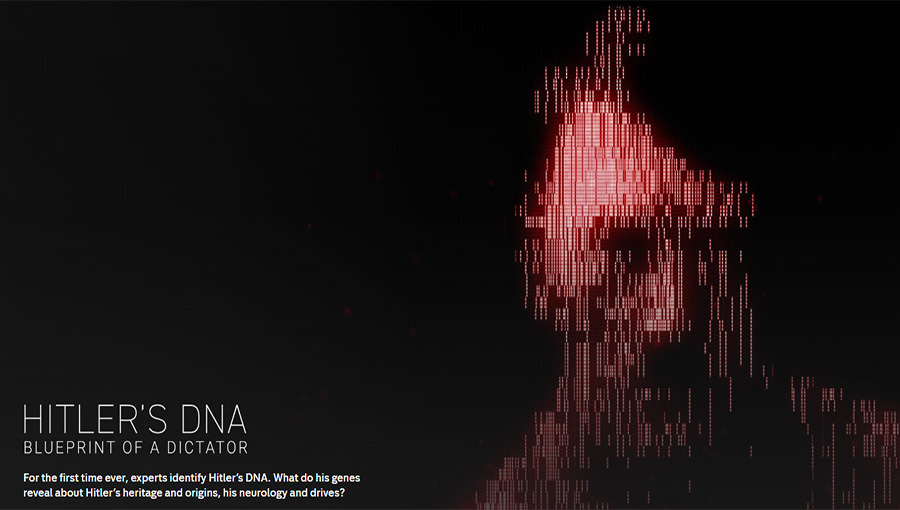
The claims are based on a UK Channel 4 “documentary” Hitler’s DNA, Blueprint of a Dictator.
This “documentary” claims to have analyzed Hitler’s DNA taken from a blood sample taken from “a small piece of fabric cut from the sofa on which Hitler bled to death after shooting himself in his Berlin bunker on the afternoon of 30th April 1945.”
This DNA allegedly shows that Hitler had “one testicle,” a “micro-penis,” “autism,” and “ADHD,” all from a form of Kallmann Syndrome.
The “blood sample” comes from a piece of fabric held in the privately run Museum of History in Gettysburg, owned by one Erik Dorr.
Dorr believes that the fabric is genuine, as he bought it in February 2014 at Alexander Historical Auctions, a Maryland-based company, at a cost of $16,000.
The piece of the couch was allegedly taken by United States Army Colonel Roswell P. Rosengren, who served during most of World War II as public information officer for General Dwight D. Eisenhower, said Bill Panagopulos, president of Alexander Historical Auctions.
According to Panagopulos, “A few days after Hitler committed suicide by a pistol shot to the head, Rosengren and a few fellow American officers were let into the dictator’s air raid bunker by the Soviet forces, which controlled that portion of Berlin,” Panagopulos said. Rosengren used the opportunity to take a section of the couch, along with a few other items from the bunker.
This is where the hysterical claims all fall down. The fabric is fake, and this is why:
It is physically impossible for U.S. Army Colonel Roswell P. Rosengren to have entered Hitler’s bunker “a few days” after Hitler’s suicide and have taken the sample.
Rosengren was indeed an officer who served under Eisenhower, but no American—Rosengren included—was anywhere near the Führerbunker in early May 1945.
After Hitler committed suicide on 30 April 1945, the Soviet Red Army controlled all of central Berlin, including the Reich Chancellery and the Führerbunker, by 2 May 1945.
The Western Allies (U.S., U.K., France) were at that time hundreds of miles away, as per the Yalta agreements, which prohibited them from entering Berlin during combat.
No American troops were allowed into Berlin at all until July 1945, when the formal four-power occupation zones were activated.
Therefore no American—soldier, journalist, officer, or official—could have been physically present in the bunker “a few days” after 30 April.
Every credible historical source agrees that the first Americans allowed into the bunker arrived on 7 July 1945, escorted by the Soviets.
Rosengren was not among these Americans.
Rosengren was a U.S. Army public information officer attached to SHAEF (Supreme Headquarters Allied Expeditionary Force), serving under General Eisenhower.
At that time (April to May 1945), Eisenhower’s headquarters were in Reims, France (and later in Frankfurt).
The closest American forces to Berlin were still far west of the Elbe River the week Hitler died.
Eisenhower personally instructed U.S. forces not to push toward Berlin, leaving the city to the Soviets per Allied agreements.
Thus, Rosengren—being part of Eisenhower’s staff—was not in Berlin, not near Berlin, and not allowed into Berlin when Hitler died or in the days afterward.
From April 1–30, 1945, SHAEF’s headquarters were in Reims, France (the Collège Moderne et Technique building). Eisenhower and his staff were coordinating the Ruhr encirclement and the Elbe link-up with Soviet forces.
Because the Public Information Division conducted multiple press briefings at Reims during April, and Rosengren participated, there is recorded documentation placing him in Reims, France, all of April 1945. He is listed in the SHAEF Public Information rosters and appears in dispatches giving press guidance there.
In May 1945, he was still in Reims for the German surrender, then Frankfurt. SHAEF Public Information officers, including Rosengren, were responsible for managing the press corps present at the surrender signing on 7 May 1945.
Rosengren is documented as taking part in the press credentialing, statement preparation for Eisenhower, and coordination of reporters covering Jodl and the German delegation.
After the surrender ceremony, SHAEF moved its headquarters to Frankfurt, Germany, where it was established on 18 May 1945. Rosengren was present once again.
So Rosengren could not have visited Berlin in May 1945 under any circumstances.
On 26 May 1945, the Supreme Headquarters formally relocated to the IG Farben Building in Frankfurt am Main. Rosengren appears in internal rosters and correspondence from Frankfurt during June, and no evidence places him anywhere else.
The earliest date any American personnel entered Berlin under four-power occupation rules was 4 July 1945, the day they took over the U.S. Sector.
The first American inspection of the Führerbunker occurred on 7 July 1945, escorted by the Soviets.
Was Rosengren part of this group? No.
Could Rosengren have taken fabric from Hitler’s couch, even at a later date? The answer is once again no.
The Soviets had exclusive access to the bunker until 7 July 1945. By then, they had removed, documented, and later destroyed most items in the bunker.
The bunker was partially demolished by the Soviets before Americans ever saw it.
What did happen to Hitler’s couch?
It was photographed and examined by Soviet troops on 2–3 May 1945.
Russian archival reports describe removing fabrics, blood-stained coverings, and personal effects.
These materials went into Soviet NKVD custody, not American hands.
Thus the story of the origin of the “blood stained fabric” is clearly made up, most likely by Rosengren himself or later retellings.
The whole story is, as usual, a propaganda hoax.