Matthew Raphael Johnson (2004)
That the modern ethno-nationalist and anti-globalist resistance movement has a profound class character is difficult to deny. It has this character in a radically different manner than the far left in the media and the universities would have one believe.
The extreme left’s overrepresentation in these institutions has provided a purposely false and distorted picture of class in America, and, specifically, class conflict in relation to nationalism.
The simple fact is that the American and European nationalist movements are overwhelmingly “blue collar” and lower middle class, facing squarely the ideological arrogance of the global elite representing the internationalist ambitions of contemporary world capitalism.
Nationalism is finding its strength in those who have been displaced by the New Order of global capitalism, the overwhelming majority of workers and small businessmen who do not stand to gain from internationalization.
As a result, those who benefit from the increasingly tyrannical rule of internationalized capital have sought to mobilize the constituencies of the far left to destroy the only means whereby consistent social cooperation and political mobilization could ever come about, namely, ethnic and cultural nationalism; the re-building of the ethno-community.
To say that some phenomenon has a “class character” is to say it has a significant economic component; it is not to say that it is reducible to class, or that class structure can be used to fully explain political phenomena.
Nothing is reducible to class or any other such simplistic label invented by modern social science.
Modern ethno-nationalism has, however, one complex starting point that explains its strength, rise and obvious threat to modern American elite hegemony: the reaction to the reigning global system of trade and its necessary domestic social reorganization.
As globalized capital actively seeks the overthrow of nations and their moral standing as sovereign entities, classes victimized by this process are turning to the very idea of the nation itself as a means of retaliation.
What was once taken for granted and latent is now an active political creed. The objective reality of nationhood and culture has now been given its subjective force. Nationalism has a powerful economic component, and it thus contains a profound class component.
Global free trade has destroyed the livelihoods of not merely millions of working men but entire communities dependent upon a certain way of economic life, such as textiles or farming. The isolated consumer has replaced the active citizen and the ethno-linguistic community that forms and nurtures him.
This “mass man” has no control over the workings of the global economy and thus the transformation of citizens into consumers is more accurately understood as a function of political domination.
The American Bureau of Labor Statistics has estimated the job loss in the United States since the forced passage of NAFTA in the millions.
This means entire communities are wiped out as corporations move to the third world in search of cheap labor and a more compliant workforce.
Alternatively, America’s corporate elite have also experimented in importing third world labor to displace blue collar and poor rural Americans.
Not only do they work for less, but they are very difficult to unionize given the obvious linguistic and cultural barriers, and, more importantly to the system in general, they continually divide the working classes in America along racial lines, making any political organization nearly impossible.
In other words, the economic battle automatically takes on a national tone as the national battle immediately takes on a class tone.
As international capitalism uses cultural aliens to destroy American working class solidarity and an American sense of self, leftist views of international economics become irrelevant, given that they ignore or trivialize the national, ethnic and cultural aspects of international economic organization.
The left is a creation of capital: they are the force promoting feminism and internationalization, the two major props to control wages in the US.
Domestically, of course, in order for the United States to be merged into the new economic order of free trade and global governance, the ethnic and religious nature of the country must also be altered accordingly.
This is the crucial connection the left refuses to make, and in refusing to make this connection, they have no relevance to the struggle whatsoever.
It is clearly not in the interests of global capital, which seeks a world without borders for the sake of marketing and the maximization of consumption in standardized form, to tolerate ethnic and religious nationalism.
As a result, if globalism is to continue, ethnic homogeneity must become a thing of the past, and, certainly, the ethnic, religious and racial pride of any majority population must be eliminated completely.
The demands of the corporate elite globally mean the imposition of multiculturalism as a semi-official ruling ideology nationally. The contemporary ideologies of multiculturalism and multilingualism stem immediately from the political and social demands of international capital.
International capital cannot function profitably if peoples seek social fulfillment and cohesiveness within their own cultural structure.
Multiculturalism is part of the marketing structure of international capital.
If the world is to become one global marketplace without regard to race, nation or religion, then nationalism becomes the deadly enemy of capital.
This is the reason why nationalism – alone among political ideologies – is utterly forbidden in academia and journalism.
The ultimate in marketing efficiency is in the standardization of the market itself, which, in contemporary terms, means the standardization of the tastes, ethnicities and morals of the globe.
Richard Berry and John Cavanagh write in their celebrated (1996) essay the “Homogenization of Global Culture,” which appeared in the excellent compilation, The Case Against the Global Economy:
The owner of this global network of networks [referring to Viacom] is Sumner Redstone [sic, his real name is Murray Rothstein], a Boston multibillionaire who made a fortune in movie theaters. Although his name is unknown to the general public, he has become of the most influential educators of young people in the world. As MTV was announcing plans to extend its worldwide home entertainment networks to China, Korea and Taiwan and to launch “Ren and Stimpy” in Europe, Redstone was celebrating the arrival of the global child. “Just as teenagers are the same all over the world, children are the same all over the world,” he declared
The “mass man” has no function, no purpose, and no final end intrinsic to himself. He might find himself the tool of the bureaucrat or the industrialist, but, of himself, he is merely a means, and not an end. The mass man is purely other-directed, he is directed solely by outside forces, whether it be the pop-culture, the state apparatus, commodity producing capital, or the psychological clinician.
The mass man is the “citizen” of the modern state, the consumer of modern capital — the mass man is the microcosm of modernism and a product of its ideology. He is a “subject” in every sense of that term.
Traditional European culture — the essence of European man — was marked by the primacy of the small community, the village, the parish, and the guild. European man was intimately surrounded by various and sundry institutions that defined his role in society, his responsibilities, as well as is rewards, rights, and privileges.
Such a social regime is one championed by nationalists, medievalists, and communitarians of a specifically “rightist” stripe. It is so promoted because the citizen can truly be such, an active participant in the community fully aware of his identity and final purpose.
Only here can true individuality be found. But the individual only grows within cultural unity, and, for the myriad institutions of medieval life to flourish, they needed to be wedded together with a common vernacular and a common religious heritage, the contents of which are well known.
The rise of the modern world on the ruins of the medieval period sought the dismantling of these institutions. The progress of technology provided the state with the means to expand its reach, strength, and power.
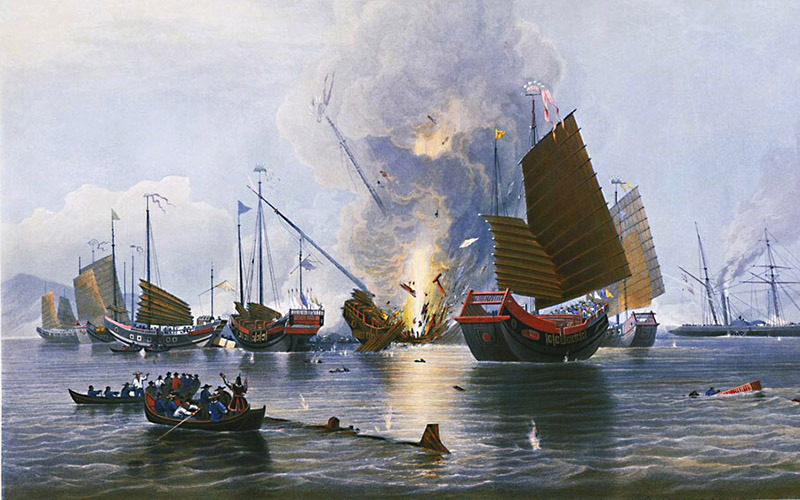
The beginnings of imperialism and colonialism were fueled by the demands of burgeoning international trade and the centralization of the state, with its mass armies and professional bureaucracies which then provided the state with the necessary financial power to expand itself.
Further, the gradual collapse of the feudal system provided European man with the first wave of entrepreneurs, often impatient with the weight of tradition upon their quest for profit. Soon, the guilds collapsed, leaving the individual craftsman completely unprotected, and religion became the function of the state as the monasteries of old were absorbed into the bureaucracy with their property.
Of course, it was not long before European man saw the fruits of the “Reformation:” capitalism, the legalization of usury, and the rationalization of bureaucratic power, in other words, the centralized state of the “absolute monarchs” of the early modern period.
Such political arrangements were conveniently justified by such philosophical works as Thomas Hobbes’ (1651) Leviathan.
European man was also treated to the creation of massive conglomerates, or concentrations of private capital with nearly as much power as the state itself.
The English and Dutch East India Companies, of themselves, became governments, with their own security services and bureaucracies. Of even greater significance was that this expansion was financed on the ruins of the former communitarian existence of European man. The path to power for the “new class” of political and economic rulers was in centralization, or, put differently, the elimination of all alternative sources of loyalty.
The “enlightened” rulers of the 16th and 17th centuries had little patience with of the weight of tradition that had previously informed the institutions of the village, parish, and guild. There was to be no interruption of the state’s power, there was to be a direct line of command from ruler to subject, and the intermediate institutions were to be eliminated.
Many simply became irrelevant under the weight of the new class of “civil servants” and financiers. Soon enough, of course, Hobbes, Locke, Voltaire, Rousseau, and a host of others were justifying the systems that had taken most of Europe by mocking and denigrating the institutions of the Old System: Religion was superstition, tradition was little more than “habit,” and humanity was to live solely by its own “individual reason.”
Man became a mere “citizen” of something called the “nation-state,” that odd institution which served to protect the ruler’s unlimited power and capital’s ever-expanding tendencies.
In order to rule such vast territories, both political and economic power became more “abstract.” As states grew along with markets, European man began to seem a undifferentiated mass rather than making up a set of well-defined roles and responsibilities.
Man became an abstract “citizen” rather than a soldier, priest or carpenter. For political and economic power to reach ever expanding markets and territories, standardization became the norm.
The particularistic culture of the village, the monastery, the guild or the region, became the monoculture of the state and its attendant capital (or vice versa). With this came the rise of mass ideology, or that series of abstractions which was the instrument of the new class of rulers.
Locke and Marx posited man as a mere producer, a machine of production. Hobbes saw man as a chunk of matter forever in motion, clashing with other chunks of matter. Le Mettrie saw man as merely a machine. The Marquis de Sade saw women as “machines for voluptuousness.” Regardless of the ideology, man was reduced to a set of ideological abstractions as he was torn from his earlier set of definite institutions and roles.
No such arrangement can work without the exercise of power. Modernism did not merely “rise to power” as the intellectual historians claim, using the ever-present “passive voice” of the academic classes, but was something imposed by force.
Independent cities, communes, republics, and regions were forcibly subjugated to the ever-expanding power of the state and its growing armies and arsenals.
The rise of finance capital made it possible for the state to finance long term military operations and massive armed forces. In short, both from the point of view of the concentrated state as well as concentrated capital, the community of traditional Christian Europe was a hindrance.
The state demanded loyalty to it and it alone, while capital needed an undifferentiated population to continue the expansion of markets at the lowest possible cost. This process has yet to cease; only its scope has changed.
By the time of the French Revolution at the late eighteenth century, Edmund Burke, Joseph de Maistre, Johann Herder and a handful of others stood up against the entire project of modernity and its demand for centralization and standardization.
The intellectual pedigree of this resistance became (in the philosophical sense) “conservatism,” and later, “nationalism,” “communitarianism,” and “devolutionism.”
In spite of this, modernity continued its long march, man was bereft of a true identity. He was the subject of political and economic forces he could not hope to control. Decisions were made at distant capitals and centers of financial and industrial power.
As man lost a sense of personal responsibility and became a pawn in the hands of massively powerful social forces, the official political ideologies of the “New Men” reflected European man’s new condition: Darwinism, Determinism, Existentialism, and Marxism became the new creeds for the New Man.
Marx placed man at the behest of economic forces, Nietzsche saw man as inevitably manifesting the uncontrollable “will to power,” while Freud placed man at the behest of the two major instincts of the psyche — lust and death.
Ideology was humanity exploring his new found shackles. The very concept of reason and science had been redefined in a way congenial to the new ideologies of European man. All of them reflected the new regime: the system of politics and economics that decidedly saw humanity as the raw material for the increased power and expansion of the New Men.
Mankind eventually was sent to die by the millions in two world wars, and sent to the factory to be worked into an early grave for the New Class. Hence the present difficulties are reached.
This all too brief and simplified historical sketch has landed at the end of the twentieth century.
The final conclusion is that man is a social being indeed, but he is not a part of a “mass.” Man’s place as a social being means that man is also a cultural being, a being capable of powerful impulses of affection, loyalty, and a deep civic kinship developed while acting within strictly defined social roles and moral norms.
These impulses towards the community are not irrational, but are based on man’s natural attachment to the social forms which provide him with a sense of identity and purpose.
Man’s natural sociality means that this sense is in no way arbitrary — in that man’s identity in community is not arbitrary — but that social life is something that exists to solve definite needs and problems, needs that belong to man as man.
The cultural identity which comes to create the ethnos, peoples, and clans, is merely the means by which the natural law of human sociality manifests itself in the day to day moral decision-making of a cultural being.
The communal sense of nationhood which at one time dominated European morals, and made another appearance at the end of the eighteenth century and into the nineteenth (though, sadly, at the behest of the mass-state), still shows itself as the true, natural social milieu of human beings.
The local community is part of the national and ethnic unit that expresses man’s natural sociality in small, devolved forms that permit the family (the basis of all social life), identity and belonging to flourish.
Authority is something that emanates from cultural forms, in that such forms contain the wisdom of the ages as the repository for generations of experience, victory, defeat, suffering and happiness.
This instinct, in turn, is based on nature itself, for human beings solve problems in community: man is incapable of a solitary life, man is not physically or psychologically self-sufficient. The small community, manifesting its solution to various human needs which is the basis of culture and morals, is the proper and primary repository for human affection and loyalty.
Here, mankind is not a “citizen,” a “consumer,” or any other abstraction of modern sociality, but a full and true human being with definite responsibilities and privileges, responsible to others as others are responsible to him.
The ethno-nation, or, even more accurately, the ethno-commune, is not related to that abstraction of the “nation-state.” The nation is something quite different, and often opposed to, the institutions of the state.
The nation is a cultural community expressing man’s natural sociality and solidarity.
The state is a formal organization of violence which intrinsically seeks to expand its power at the expense of the community and the loyalties it engenders.
The state often finds the tradition of nationhood a constant irritant to its demand for complete loyalty and ever expanding power, expressed in standardization and bureaucratization.
The term “nation-state” is incoherent and utterly irrelevant to contemporary politics.
Nationalists speak of “nation,” “community,” and “region,” while liberals, neo-conservatives, Marxists, and capitalists speak in terms of “state.” In many ways, the modern follower of Johann Herder might be termed an ethno-communitarian anarchist, where governing power is not found in the distant bureaucratic state, but in the developing forms of cultural tradition, created and maintained by the constant interaction of more or less autonomous institutions and estates, themselves the produce of centuries of accumulated historical experience.