By Arthur Kemp. The online world media recently erupted into a frenzy of reporting claims that massive underground structures extending more than 2,125 feet (648 meters) had been discovered beneath the Pyramids of Giza.
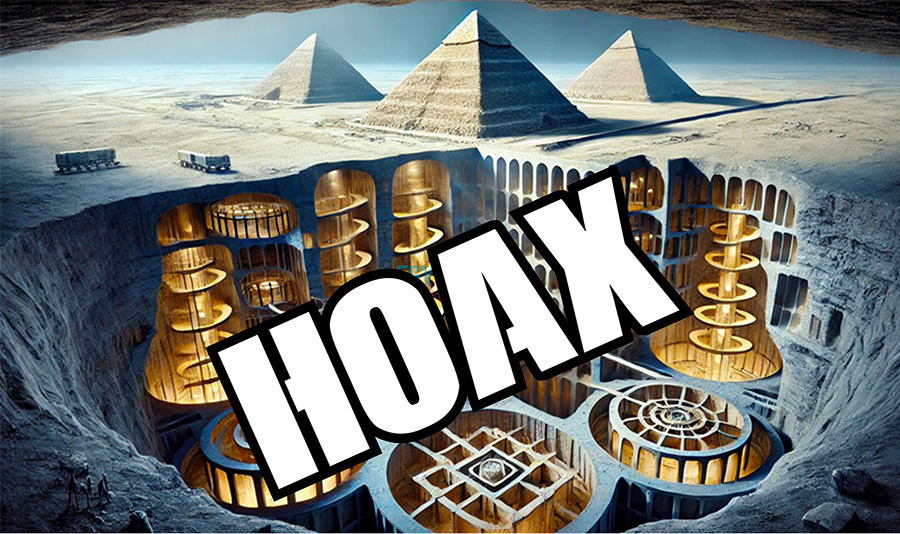
Although these claims are, architecturally speaking, simply preposterous and, as will be shown below, utterly fake, the “chambers beneath the pyramids” story is quickly becoming accepted as “truth,” especially on social media, where it has been endlessly repeated.
The emergence of the “chambers beneath the pyramids” story serves as a valuable lesson in how fake history and fake news can be generated in today’s online world. Although there have always been fringe theories in existence—see, for example, the “Bermuda Triangle” theory—it is without doubt the ready availability of the internet that has greatly accelerated the distribution of crank theories and beliefs.
The Bermuda Triangle theory emerged when claims first appeared in a series of sensationalized articles in 1960s pulp magazines like “Argosy” and “American Legion Magazine,” asserting that a handful of aircraft and sea vessels had mysteriously disappeared without trace in the sea between Miami, Bermuda, and San Juan, Puerto Rico, during the period 1918 to 1945.
The belief reached a peak with the 1974 book “The Bermuda Triangle” by conspiracy author Charles Berlitz. This wild tale, full of the most shocking exaggeration, sold millions of copies during a brief burst of mania over the issue.
By the end of the 1970s, however, thorough analysis and research showed that many of the “vanished” claims had been fabricated, and that the number of actual lost planes and ships in that region was no higher than anywhere else.
The thorough debunking of the theory, combined with the fact that there have been almost no “disappearances” in modern times (that is, from 1945 to the present day), has caused the theory to be largely discarded, although it briefly resurfaced as a curiosity in films (“Triangle,” 2009) and TV shows (“The X-Files”).
PYRAMID OF GIZA ‘STRUCTURES’
In the same vein as the Bermuda Triangle myth, a team of Italian and Scottish researchers announced to the world in March 2025 that they had discovered an incredible—and, to many people, unbelievable—massive underground complex beneath the Pyramid of Khafre, one of the three main pyramids at the Giza Plateau in Egypt.
Their findings, described as a “vast underground city,” include eight vertical cylindrical shafts (33–39 feet in diameter) extending over 2,100 feet deep, spiral staircases, two massive cube-shaped chambers (each 262 feet per side), and a water system with pipelines potentially reaching depths of 4,000–6,500 feet.
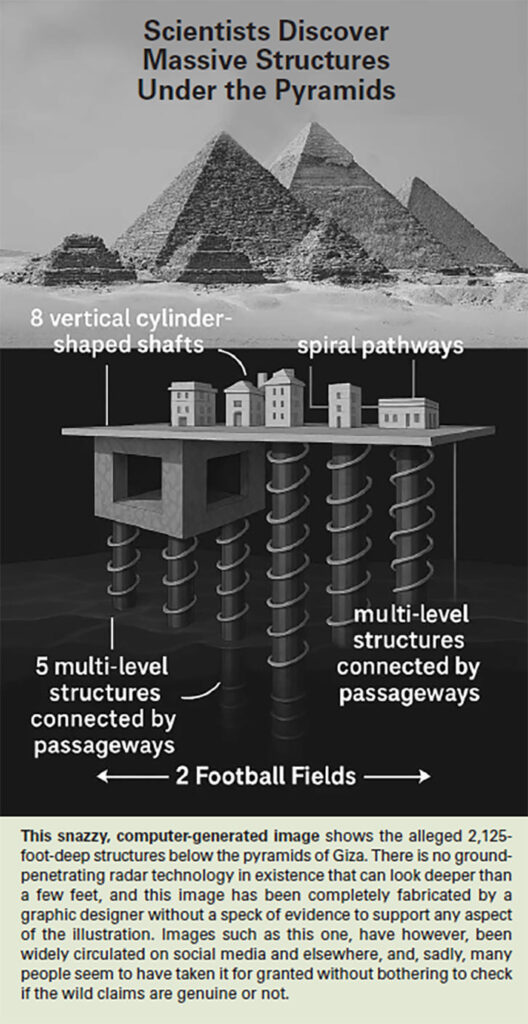
The researchers claimed these structures could be linked to the “Halls of Amenti” or the “Hall of Records” and even claimed they are 38,000 years old. These two “halls” are supposedly vast subterranean complexes beneath the Giza Plateau which house some sort of “cosmic wisdom.” The Halls of Amenti in particular are linked to the pseudohistorical fabrication known as the “Emerald Tablets of Thoth.” (1)
The claims also referenced the “Younger Dryas hypothesis,” a theory that suggests an asteroid or other massive climatic event occurred around 10,850 B.C. According to some scholars, this event wiped out several civilizations that were as old as 40,000 years. One of these ancient civilizations, this theory says, built the alleged structures below the pyramids.
Finally, a later claim in March 2025 alleged that a “sarcophagus” 600 feet below the Tomb of Osiris, a symbolic burial site, had also been detected.
The claims were announced at a press conference on March 15, 2025, at the Hotel Artemide Congressi in Bologna, Italy, organized by an organization calling itself the Khafre Project. The event was live-streamed and promoted through social media and press releases.

Subsequent details were shared in media interviews (specifically in the United Kingdom’s tabloid newspapers such as the “Daily Mail” and “The Sun”) and a video by project spokesperson Nicole Ciccolo on March 23, 2025, discussing the findings.
The claims gained significant traction online, where they were amplified by media personalities such as Alex Jones and Greg Reese, who linked them to theories of the pyramids as ancient energy systems. Social media posts on “X” fueled speculation, but almost all of the images they used were AI-generated and not even the original ones—which were bizarre enough on their own—as released at the Khafre Project’s press conference.
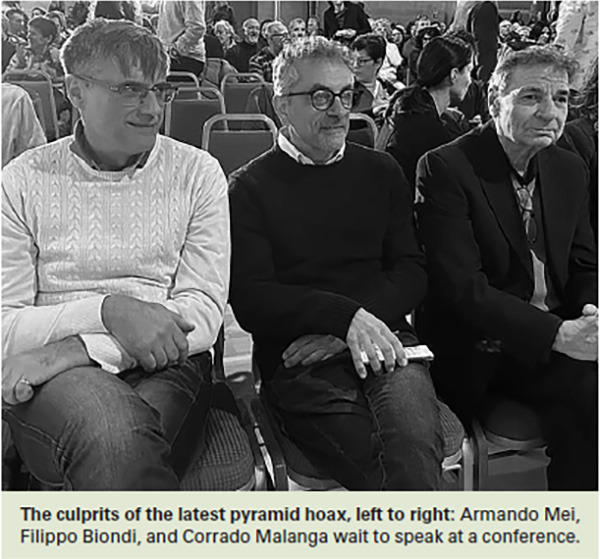
The Khafre Project team is led by Corrado Malanga, a former professor of organic chemistry at the University of Pisa, already well-known for promoting fringe theories in Ufology and alien abductions; Filippo Biondi, a researcher from the University of Strathclyde, Scotland; and Armando Mei, a self-described Egyptologist.
The team claimed to have used Synthetic Aperture Radar (SAR) technology, combining satellite radar data with Doppler shift seismic vibrations and Doppler Tomography, to map the alleged structures, claiming that high-resolution images revealed the underground formations.
THE TECHNOLOGY
These technologies are real. SAR works by emitting microwave pulses from a moving platform, such as a satellite or aircraft, and is commonly used across a wide range of scientific applications, mostly from satellites, primarily to determine topographic features of a landscape or area.
The Doppler shift is an observable phenomenon that records a change in a wave’s frequency (or wavelength) when the source of the wave and the observer are moving relative to each other. This combined movement results in a higher frequency being recorded when the observer is approaching the wave source, and a lower frequency when moving away from the wave source—even though the wave remains constant at its origin.
Doppler Tomography is an advanced imaging technique used primarily in astrophysics. It works by reconstructing two-dimensional “velocity maps” of astronomical objects.
A “velocity map” is a graphical representation of the intensity of light (or other electromagnetic radiation) being emitted by the object under observation.
This mapping process produces what are called “spectral line profiles.” These provide information about the physical conditions of the object being studied, such as temperature, pressure, velocity, and composition, which in turn allows scientists to draw conclusions about how fast atoms and other particles are moving within the object.
THE CLAIMS DETAILED
The researchers claimed that analysis of micro-movements or subsurface vibrations via Doppler effects allowed them to create the now highly publicized 3D reconstructions of pyramid interiors and depths far beyond SAR’s effective range.
Furthermore, they claimed that SAR data from the Italian COSMOSkyMed satellite system, combined with the detection of micro-movements or vibrations within the pyramid and its subsurface—purportedly caused by background seismic waves (e.g., from wind, traffic, or natural tremors)—allowed them to capture subtle Doppler shifts in the radar signal’s frequency.
These vibrations, they claimed, were observable at the pyramid’s surface. By tracking pixel-level displacements, they measured millimetric vibrational trends over time, which they claimed were “internal structural responses.”
It was these vibrational signatures that they used to construct the three-dimensional images, with Biondi’s proprietary software allegedly converting these radar signals into “phononic information” (sound-like vibrations).
This “phononic information” is in turn interpreted as a view of the interior and subsurface down to extreme depths. The men claimed that this unique capability allowed them to overcome radar penetration limits.
THE CLAIMS ANALYZED
The problem with Biondi’s “phononic information” is that, although seismic waves can propagate through rock, their millimetric surface expression after traveling hundreds of meters is minuscule and well below SAR’s sensitivity threshold (typically 0.039 inches or between 1 and 10 millimeters).
Furthermore, the pyramid’s mass and heterogeneity would further dampen and scatter such signals, making precise deep imaging improbable, to say the least.
SAR achieves high resolution at a penetration level of three feet or less (one meter) but loses all resolution in dense media. Malanga, Biondi, and Mei’s methodology could plausibly detect anomalies via surface vibrations for shallow structures of 30 feet or less, but to believe that it could reach in excess of 2,000 feet is scientifically impossible.
Satellite-based SAR, in particular, lacks the power and direct coupling of seismic methods, and no scientist anywhere else—at NASA or other high-level institutions using SAR technology—has ever reported detecting seismic reflections at such depths from orbit.
In dry, low-conductivity materials such as sand or loose soil, SAR can only penetrate to a maximum depth of around 16 feet, and in denser, more conductive materials such as limestone or granite—common in the Giza Plateau—this penetration depth drops to less than six feet at best.
Claims of imaging 2,000 feet and more through rock defy these limits, as signal loss would render reflections undetectable beyond a few feet. These limitations are rooted in the physics of radar-wave propagation and have been consistently documented in peer-reviewed literature and real-world applications, including SAR applications on Space Shuttle missions. (2)
In summary, the claims of structures being detected thousands of feet below the pyramids using SAR and Doppler technology are highly implausible. Less charitable critics would call such claims outright lies.
WHY INVENT SUCH NONSENSE?
Given that these claims are clearly nonsense, the question then immediately arises as to why anybody would make up these fantastic allegations if they are unsupported by science, technology, architectural reality, or any facts at all.
Herein lies the real issue: how and why “fake news” and false allegations are developed. History—and 20th century history in particular—is brimming with absurd and impossible claims made by all manner of people and widely believed despite all the facts being readily available.
The answer to this question lies within the realm of psychology.
According to official figures, specifically from the “Diagnostic and Statistical Manual of Mental Disorders,” (3) the lifetime prevalence of delusional disorder is approximately 0.2% globally, or about 24–30 cases per 100,000 people.
These figures, however, are for severe delusional cases, and the statistics for “occasional” or “episodic” delusions—often initiated by reactions to drugs, alcohol, or other environmental factors—are much higher.
For example, according to the 2007 “Australian National Survey of Mental Health and Wellbeing,” (4) 8.4% of the general population endorse delusional-like beliefs at some point, though these are typically less severe and not necessarily indicative of a clinical disorder.
With reference to the Khafre Project, it is important to state here that there is, to date, no clinical evidence that anyone associated with the “pyramid chambers” claim suffers from any mental illness.
However, a review of their previously published research provides some disturbing indications.
Malanga, for example, in his work “Alien Cicatrix,” (5) wrote that “aliens” in UFOs are actually inter-dimensional creatures that “hijack” human souls in order to survive. As he put it in that work:
“The soul is used in a regeneration cycle: it enters in the alien’s body that has his own mind and spirit (AAM), and revitalizes it, so to guarantee his physical survival….”
“Through this operation [taking out the soul], repeated at least twice a year, the soul revitalizes the alien, which in this way will not die, neither in his body, nor in his spirit and mind.”
“To be more clear, each abductee has only one AAM, but she supplies her energy, through her soul to a bunch of aliens: the Saurian, the Insectoid, the Heart-shaped and the Five-fingered blonde (Orange).” (6)
In a 2013 interview, Malanga went on to claim that these “aliens” seek to “create some genetic bridge which will alter their own alien DNA to be compatible with our souls,” and that “the human souls will be hijacked into complete alien enslavement.”
He added:
“Ultimately they want to create some genetic bridge which will alter their own alien DNA to be compatible with our souls (via various human-alien hybrids). Once they have created a genetic hybrid with DNA that is compatible with our human soul frequency is when the human souls will be hijacked into complete alien enslavement.” (7)
Bizarre would be a mild description for this theory, but it may provide a clue as to Malanga’s motivation for engaging in the incredible delusions about ancient advanced civilizational structures in ancient Egypt.
His colleague, Armando Mei, has previously published several books in which he claimed the existence of a mysterious predynastic lost Egyptian civilization. His books assert that the Giza pyramids were built by a civilization that existed an incredible 38,000 years ago (36,420 B.C., to be precise), during what he called “Zep Tepi,” a mythical “First Time” which possessed advanced knowledge. Although completely unproven, Mei has published no fewer than four books on the topic from 2008 to 2014, each one proposing new theories on the building of the Giza pyramids. (8)
This, then, would explain Mei’s desire to be involved in a project that makes equally incredulous claims about superstructures under the pyramids, as his level of factual basis for his theories is already abysmally low, as demonstrated by his unsupported claims of 36,000-year-old pyramids.
Although Filippo Biondi, the originator of the “Synthetic Aperture Radar Doppler Tomography” (9) used to produce the claims of the subterranean structures beneath the Giza pyramids, has no documented track record of eccentricity, his claim that his technology can penetrate to 2,000 or more feet below the surface is most certainly delusional.
As a result, his “phononic information” and claims of seeing “through solid stone” (e.g., granite as “transparent,” per their March 15, 2025, press conference) are simply untrue.
His decision to ally himself with “alien soul sucking” theorist Malanga and Mei’s 38,000-year-old pyramid theory should serve as a warning sign regarding the already dubious plausibility of his work and his ability to accurately judge facts.
In conclusion, it can be safely said that there is no scientific basis for the claims that there are structures more than 2,000 feet below the Giza pyramids; that the methodology used to develop the images of such structures is implausible; and, finally, that at least two of the individuals involved have past records as fringe eccentrics who dabble in all manner of unprovable hypotheses.
Despite this, the belief in massive “underground structures” is already spreading quickly, and, unless people of good will and common sense speak out, might yet enter the annals of “truth,” like so many other historical myths.
ENDNOTES:
1. The “Emerald Tablets of Thoth,” invented by the well-known crank “Maurice Doreal” (real name Claude D. Dodgin, 1898–1963), founder of the Sedalia, Colorado-based “Brotherhood of the White Temple,” which promotes a large number of bizarre theories about Atlantis, cosmic laws, and apocalyptic prophecies. Doreal claimed that, during a 1925 visit to the Great Pyramids of Giza, he discovered a set of ancient emerald tablets inscribed by the Egyptian god Thoth, who he reimagined as an Atlantean king rather than solely an Egyptian deity. He asserted that he was tasked by spiritual entities or a “Pyramid Priesthood” to translate these tablets from the “Atlantean language” into English for modern enlightenment. The tablets, of course, have never actually existed.
2. On the limitations of SAR penetration technology, see: “Subsurface Imaging in South-Central Egypt Using Low-Frequency Radar: Bir Safsaf Revisited,” Paillou, P., et al., IEEE Transactions on Geoscience and Remote Sensing, Vol. 41, No. 7, pp. 1672–1684, July 2003. This paper documents SAR penetration of 1–2 meters in dry sand and less in denser materials; “Space Radar Image of Safsaf Oasis, Egypt,” SIR-C/X-SAR mission data, NASA Jet Propulsion Laboratory (JPL), April 15, 1999, jpl.nasa.gov. This confirmed SAR penetration levels from space as 6.5 feet in very dry sand; and Principles of Remote Sensing: An Introductory Textbook, Tempfli, K., et al., ITC Educational Textbook Series, Vol. 2, International Institute for Geo-Information Science and Earth Observation, Enschede, 2009. This textbook explains that SAR penetration in solid rock is constrained to “a few wavelengths” (e.g., 0.3–1 meter for L-band), with practical limits rarely exceeding 2–3 meters (six-tonine feet) in geological contexts.
3. American Psychiatric Association, DSM-5 Task Force. Diagnostic and Statistical Manual of Mental Disorders: DSM-5™ (5th ed.). American Psychiatric Publishing, Inc., 2013.
4. Saha, S., Scott, J.G., Varghese, D., & McGrath, J.J. “The association between delusional-like experiences, and tobacco use and alcohol consumption in the general population.” Psychiatry Research, 189(2), 268–273, 2011.
5. “Alien Cicatrix,” Dr. Corrado Malanga, self-published, Pisa, March 2005. Partly translated and published in English as “The Global Picture of the Alien Interferences, Complete Multilingual Bibliography,” 2017, archive.org.
6. Ibid., page 2.
7. “Alien Hierarchies and the Research of Dr. Corrado Malanga: An Interview with Dr. Malanga through Dorica Manu,” evelorgen.com, February 28, 2013.
8. Armando Mei’s books on his invented 36,000-year-old civilization include: “36.420 a.C–Le Piramidi Satellite ed il Codice Segreto,” 2008; “La Piramide e i Segreti del 137,” Edizioni Polistampa, 2014; “Il Segreto degli Dei: Un viaggio tra Scienza, Qaballah e Alchimia,” self-published via Amazon, 2014; “Ancient Mysteries: Collection of Author’s Articles Published on the Main Specialized Journals,” self-published via Amazon, 2016.
9. “Synthetic Aperture Radar Doppler Tomography Reveals Details of Undiscovered High-Resolution Internal Structure of the Great Pyramid of Giza,” Biondi, F., Malanga, C., Remote Sensing 14, no. 20: 5231, 2022.
This article originally appeared in the July/August edition of The Barnes Review.