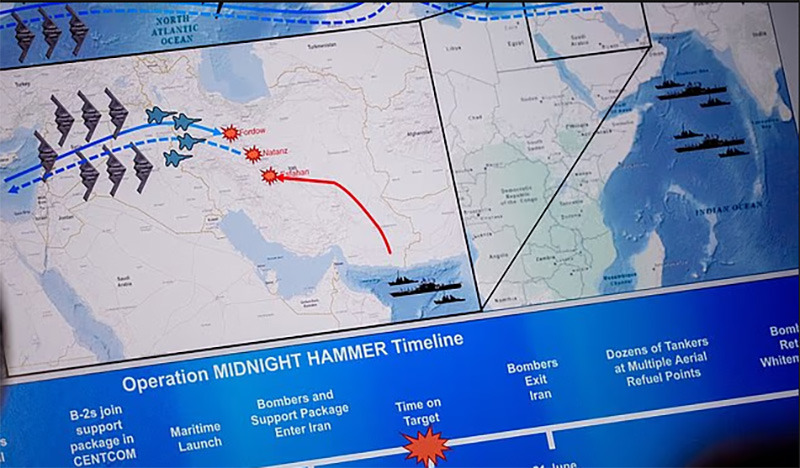
The constitutionally illegal attack on Iran, ordered by U.S. President Donald Trump, has resulted in new enemies of America around the world and has dramatically raised the danger of asymmetrical attacks against American civilians and military bases.
Apart from Iran, Hamas, and Hezbollah—who all predictably condemned the attack—the following nations have all joined in the growing worldwide condemnation:
1. Oman: On June 22, 2025, the official Oman News Agency announced that the “Sultanate expressed profound concern and condemnation over the escalation caused by the United States’ direct airstrikes on targets within Iran.”
2. Iraq: On June 22, 2025, the Iraqi government spokesman Basim Alawadi condemned the attack, saying, “This military escalation constitutes a grave threat to peace and security in the Middle East and poses serious risks to regional stability.”
3. Russia (nuclear): On June 22, 2025, the Russian Foreign Ministry issued a statement saying that “Russia strongly condemned the U.S. attack,” calling it “irresponsible and a gross violation of international law. The U.N. Security Council must put an end to confrontational acts by Israel and the United States.”
4. China (nuclear): On June 22, 2025, the Chinese Foreign Ministry issued a statement saying that the “actions of the United States seriously violated the purposes and principles of the U.N. Charter and international law, and have exacerbated tensions in the Middle East.”
5. Pakistan (nuclear): On June 22, 2025, the Pakistani government issued a statement saying that the “U.S. strikes violate all norms of international law and Iran has the legitimate right to defend itself.”
6. Chile: On June 22, 2025, Chilean President Gabriel Boric issued a statement condemning the attack, saying that his nation “will defend respect for international humanitarian law at all times. Having power does not authorize you to use it in violation of the rules we have established as humanity. Even if you are the United States.”
7. Venezuela: On June 22, 2025, a spokesman from the Venezuelan Foreign Affairs Ministry issued a statement saying that “Venezuela demands the immediate cessation of hostilities. The air assaults are a violation of international law.”
The U.S. military strikes on Iran have significantly heightened the possibility of retaliatory attacks on Americans worldwide, according to multiple sources, including U.S. government advisories, expert analyses, and international reactions.
Iran and its proxies have vowed retaliation, and the U.S. Department of Homeland Security (DHS) has issued warnings about an elevated threat environment.
Iran’s Vows of Retaliation: Iranian officials, including Foreign Minister Abbas Araghchi and Supreme Leader Ayatollah Ali Khamenei’s advisors, have explicitly threatened reprisals against U.S. assets and personnel, citing the strikes as a violation of sovereignty and international law.
“If the Americans decide to get involved militarily, we have no choice but to retaliate wherever we find the targets necessary to be acted upon. That is clear and simple. Because we are acting in self-defense.”—Iranian Deputy Foreign Minister Majid Takht-Ravanchi, in an interview with CNN’s Christiane Amanpour, June 18, 2025.
Proxy Threats: Iran-backed groups, such as the Houthis in Yemen and militias in Iraq and Syria, have signaled readiness to target U.S. forces and interests, building on their history of attacks, such as the January 2024 drone strike in Jordan that killed three American soldiers.
“Trump must bear the consequences.”—Hizam al-Assad, Houthi political bureau member, in a social media post, June 22, 2025.
Global Threat Environment: The DHS National Terrorism Advisory System (NTAS) bulletin on June 22, 2025, warns of increased risks of cyberattacks and terrorism in the U.S., potentially inspired by Iranian calls for violence or anti-American sentiment.
“The ongoing Iran conflict is causing a heightened threat environment in the United States. Low-level cyber attacks against US networks by pro-Iranian hacktivists are likely, and cyber actors affiliated with the Iranian government may conduct attacks against US networks. Iran also has a long-standing commitment to target US Government officials it views as responsible for the death of an Iranian military commander killed in January 2020.”—DHS National Terrorism Advisory System Bulletin, issued June 22, 2025.
“The likelihood of violent extremists in the Homeland independently mobilizing to violence in response to the conflict would likely increase if Iranian leadership issued a religious ruling calling for retaliatory violence against targets in the Homeland.”—DHS NTAS Bulletin, June 22, 2025.
Regional Vulnerabilities: Over 40,000 U.S. troops stationed in the Middle East, particularly in Bahrain, Qatar, and the UAE, are within range of Iranian missiles and drones, making them prime targets for retaliation.
“All US assets in the region, the 40,000 US personnel and troops in the region, have now become targets for potential Iranian reprisal.”—Shahram Akbarzadeh, director of the Middle East Studies Forum at Deakin University, Australia, quoted by Reuters, June 22, 2025.
Civilian Risks: Americans traveling or residing abroad, especially in the Middle East, face heightened risks from terrorist attacks or kidnappings, as reflected in public sentiment on social media and expert warnings.